Friday, 27 November 2015

Millbrook 1984


MILLBROOK


33 XXX


47 XXX
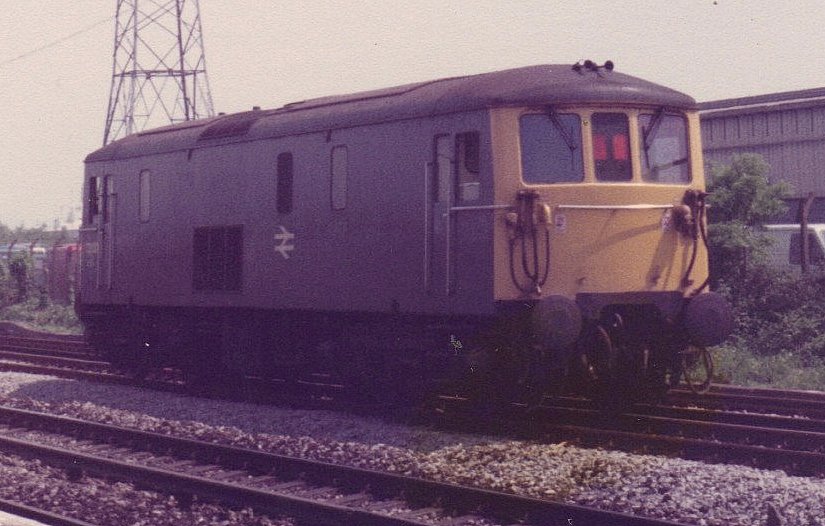

73 130


73 XXX


1126


6072

(All 24.5.1984 copyright Steve Sainsbury/Rail Thing)


An hour or so at Millbrook back in 1984 produced plenty of variety with classes 33, 47 and 73 on various trains and light engine, plus some older slam door units on stopping trains. I've never been a big fan of island platforms for photography, although their reduced cost appeals to the economist in me!

More info (from Wikipedia)
Millbrook railway station is a small station in the Millbrook area of Southampton, England.
The station is served mainly by the Salisbury to Romsey stopping service. This service runs once per hour in each direction. The station is run by South West Trains. The platforms face the slow lines only, there are no platforms for the fast lines.
Millbrook Freightliner Terminal is located next to the station on the up side. A car terminal and rail access to Southampton's Western Docks can be seen from the down side of the station.

Services

Preceding stationNational Rail National RailFollowing station
Southampton CentralSouth West TrainsRedbridge
Historical railways
SouthamptonLondon & South Western Railway
Andover and Redbridge railway
Redbridge

Passing trains and freight traffic


The Freightliner Terminal at Millbrook
It is popular with railway enthusiasts due to the wide array of freight and passenger trains which stop and pass through. Services into Southampton Central which pass through Millbrook include: the Weymouth - London Waterloo services normally Class 444s, the Southampton Central - Wareham services, normally Class 450s, the First Great Western Cardiff Central - Portsmouth Harbour service normally a Class 158 but often a 150, the Westbury - Southampton shorts either a 150 or 153, the SWT local service to/from Salisbury to Romsey with a Class 158 and also the CrossCountry service to/from Bournemouth to Birmingham and beyond which are operated by the Voyager fleet.
The freight traffic is also frequent as the Millbrook Freightliner Terminal is behind the station, with frequent Freightliner Class 66s hauling containers to Leeds and Cardiff. More freight services withEWS operate daily intermodal trains into the docks and also a car/van train which operates most days. Passing though the station as well are Freightliner Class 66s on intermodal or heavy haul, EWS 66s on intermodal, petroleum or engineers; Mendip Rail's Class 59s operating stone trains and GBRf's daily gypsum service into the docks. The future of the freight looks promising with EWS and Freightliner continually increasing the freight traffic into Southampton. SoonDRS traction may also pass through, if they win the MoD contract operating out of Marchwood.
Heritage traction are also frequent visitors to the South with occasional DRS Class 37s running on Serco test trains, and in the summer seasons diesel and steam tours pass though. Steam trains include: TangmereClan Line and Lord Nelson. The latest diesel traction includes Riviera Class 47s and EWS Class 37s on Pathfinder Tours.
Annual rail passenger usage*
2004/05 20,937
2005/06Increase 21,122
2006/07Increase 21,992
2007/08Increase 29,265
2008/09Decrease 27,422
2009/10Increase 29,936
2010/11Increase 33,418
2011/12Decrease 31,362
2012/13Increase 31,850
2013/14Increase 39,340

Thursday, 26 November 2015

North Sunderland Light Railway

SEAHOUSES


Bamburgh locomotive


3 above Seahouses station


Chathill

(All pics sourced via Google)


One of the light railways that I don't know a lot about is the one that ran from Chathill on the East Coast Main Line to Seahouses on the North Sea coast. I've actually been to Chathill station but at the time had no idea it was once a junction!

More info (from Wikipedia)
The North Sunderland Railway was a four-mile single track branch railway line in NorthumberlandEngland, that ran from Chathill on the East Coast Main Line to Seahouses via the station of North Sunderland with a proposed extension to Bamburgh.

History

Opening

Authorised in 1892 the North Sunderland Railway was built privately to serve the newly constructed harbour at Seahouses. Construction started in 1896, and the line opened in 1898 for freight on 1 August, and passengers on 18 December.

Operation

The line was rarely profitable and thus the proposed station at Fleetham, and the extension to Bamburgh were never constructed. Management of the line was taken over by the LNER in 1939. Trains took 20mins. on the branch, with 6 trains a day before closure. It was initially operated by Manning Wardle 0-6-0 Bamburgh, which was scrapped about 1948. 'Bamburgh' was replaced by an 0-4-0 Armstrong Whitworth diesel electric locomotive, 'Lady Armstrong', delivered in 1934. They were replaced until closure by NER Class H (LNER Class Y7) and passenger trains had two Great Eastern Railway 6-wheel coaches.

Closure

The line closed on 27 October 1951 and was officially wound up in April 1952.


Wednesday, 25 November 2015

Steam coming to Shillingstone!


SHILLINGSTONE


30075


30076


30075 


These locos could be found all over the place! China had loads of industrials that looked like USA type tanks but most were actually of Polish origin. This is a genuine Porter example, allegedly 7544 of 1943, seen at Benxi Steelworks in 1986.


Fantastic and surprising news from Shillingstone - not just one but TWO steam locomotives are coming to the station, making that three steam locos based permanently on the line - and all three should be working for the 50th anniversary of the original 'closure' in March 2016.

The following is from the Project 62 website

Both ‘Project 62’, representing owners of 0-6-0T locomotive 30075 and 30076, and the North Dorset Railway Trust are pleased to announce that agreement has been reached between the two parties to move the locomotives to the headquarters of the NDRT at the former Somerset & Dorset (S&D) line station at Shillingstone in Dorset. It is hoped that the move will be completed by the end of 2015 and both Groups are looking forward to working together in the future.
30075 will be moving from the Great Central Railway (Nottingham) base at Ruddington where it has been stored for display since early 2014. It has not seen any use there as it has been out of service since withdrawn at the Mid Hants Railway in late 2010. The locomotive requires repairs to its fire box and a 10 year overhaul of its boiler and running gear. It is planned to return this locomotive to operational condition first, and as quickly as practical.
On arrival at Shillingstone 30075 will initially be placed at the end of the main line but will be re-positioned in front of the station platform in time of the 50th Anniversary of closure of the Somerset & Dorset next March. 30076 will be placed in the Cattle Dock siding.
It is not known if USA type tank locomotives ever ran officially on the S&D. However, anecdotal evidence suggests that this design of locomotive was hauled over the line in the lead up to D–Day in WW2, and then after, for on-ward movement to mainland Europe. The secrecy surrounding all movements of troops and equipment at this time means that any such movements are believed to have gone undocumented.

About Project 62

Project 62 represents the owners of Yugoslavian built Class 62 USA type 0-6-0 tank steam locomotive 30075 (formerly JZ 62-669 acquired from Store Steel in Slovenia in 1990) which, having been most recently operational since June 2004, is now out of service pending firebox repairs and full overhaul. The group is also involved in the current project to construct 30076 from 62-521, which was acquired from ArcelorMittal Zenica in Bosnia & Herzegovina in December 2006. Class 62 "Yankee Tank" steam locomotives are a pattern build of the World War II USATC S100 Class 0-6-0T Switcher/Shunters designed by Colonel Howard G Hill. Many of these locomotives saw service in the UK - including 14 on the Southern Railway plus a number in industrial service with Austin Motors/BMC at Longbridge, the NCB in the North East and on the Longmoor Military Railway. Four original US built and two Yugoslavian built locomotives are preserved in the UK.

Further Project 62 information and photos

Technical Information - specification detail for 30075 (62-669) and 30076 (62-521) with dimensions, tractive effort and other data
Background to Project 62 - for more detail about the history of "Yankee Tank"
Share Scheme - buy a share to join us and be an owner of your VERY OWN steam locomotive!

Tuesday, 24 November 2015

Gartell Railway work day 22.11.2015

Activity from last Sunday at the GLR. 'Out the line' with four teenagers and two, er... 'mature' types! The four lads did a great job, and their ages added up to just slightly more than mine, and just slightly less than C.J's. (John Penny)


A view from the 'other side' just prior to us heading out the line. The banner is off No. 14 (section signal) seen on the corner ahead.


Red set 101 gets the 'Santa' boards ready for a school bazaar on December 5th. We're just running the trains so know no other detail. Come along and support it anyway!!


Chandler gets stuck in on Common Lane No10 with the replacement signal head. Although only 16 years old there is not much he can't do in the GLR wiring department!


Meanwhile here is Chandler's Grandad working on the replacement signal head on the other 'road' at Common Lane. Along with Matt 1 they're tightening their nuts.


Down at the 'End of the World' the lads get stuck into the vegetation.


Matt 2 gets to grips with his big weapon.


C.J. sharpens up his tool.


What is it with blokes and bonfires? The dry detritus at the foot of the embankment is carefully burned off as Matt 2 is talked out of doing a headlong dive into the flames.


Having just had a look at the old cattle creep, I snapped the boys building up to the last bonfire of the day. Not the most exciting viewpoint but at least it is a new one!


The light is fading as we head for home to bath the innumerable scratches, remove the thorns from our anatomy and have a good soak in the bath to get rid of the smell of bonfire smoke.

(All pics, text and captions by John Penny at Gartell Railway).


The Gartell Railway has now finished running its regular trains for 2015. This is a great set of shots showing the really fun side of rail work - choppoing and bonfires! It's really good to see that the Gartell has a team of younger volunteers, something all lines need as older volunteers enter their dotage!

Monday, 23 November 2015

Tibidabo Tramway, Barcelona


(All pics copyright Steve Sainsbury/Rail Thing)


It's not often I stumble on a tramway or railway that I don't now about, but this was a genuine surprise in Barcelona. Now Barcelona has recently built an excellent new tram system, in two discrete parts, but this is a survival from the original Barcelona tram network, which was unusual in that it ran double-deckers. In fact until quite recently it was, amazingly, the ONLY tramway in mainland Spain.

It runs for about a mile from Ave. Tibidabo to the foot of the funicular that continues up to the funfair at the top. We caught it in the rain on a Sunday afternoon, and despite running services in convoy the trams were packed!

I would of course prefer to see a modern tramway, but this does serve a genuine transport need and has done so since 1901. Hopefully in the future it will once again be connected to a city wide tramway system.

(To those who complain when I add foreign pieces to this blog, remember that a search for 'Tibidabo' will bring people who have no idea that the New S&D exists to this blog!)

More info (from Wikipedia)

The Tramvia Blau (Catalan for "blue tramway") is one of Barcelona's three tram systems. It is a 1.276 kilometres (0.793 mi) long heritage streetcar line serving a hilly area of the Sarrià-Sant Gervasi district between the terminus of FGC Barcelona Metro L7 and the Funicular del Tibidabo.
The Tramvia Blau is operated by Transports Metropolitans de Barcelona (TMB) but it is not part of Autoritat del Transport Metropolità (ATM) integrated fare network. Tickets must be purchased from the tram conductor.
The Tramvia Blau is one of only two first generation tramways to survive in Spain, along with the Tranvía de Sóller on the island of Majorca.

History

The line was built at the instigation of Sr.Salvador Andreu, who was building a residential project around the axis of the Avenida Tibidabo, and was inaugurated in 1901. The line connected at Plaça Kennedy with trams of Barcelona's city system, but was independently owned. The line's own distinctive blue livery soon led to it becoming known as the Tramvia Blau.
The line suffered several changes in 1922 and 1958.
In 1954, line 7 of the Barcelona Metro was opened to Avinguda Tibidabo station under Plaça Kennedy, providing another connection to central Barcelona. However in the 1960s the city trams were withdrawn from Plaça Kennedy, cutting the Tramvia Blau off from the city network.
In 1971 the remaining tram routes of the Tranvías de Barcelona company were closed. However, the separately owned Tramvia Blau remained in operation. It continued in private ownership until 1979, when it was taken over by the city, who continued to operate it. Between 1971 and 2004, when the second generation Trambaix and Trambesòs lines opened, it was the only tram route in the city.

Operation

Infrastructure


Typical Tramvia Blau street track
The Tramvia Blau is 1.276 kilometres (0.793 mi) long, climbing a vertical distance of 93 metres (305 ft) at a maximum gradient of 8%. It is constructed to 1,435 mm (4 ft 8 12 in) gauge and is double track, apart from single track stub terminals at each terminus. It runs in the Avinguda Tibidabo throughout, and is not segregated from other traffic.
The line's depot is accessed by some 100 metres (330 ft) of single track, which is not used in passenger service. The depot branch joins the main line near its midpoint, adjacent to the bridge carrying the Avinguda Tibidabo over the Ronda de Dalt.
The line serves the following stops:
UphillDownhill
  • Plaça Kennedy
  • Román Macaya
  • Josep Garí
  • Lluís Muntadas
  • Font del Racó
  • Plaça del Doctor Andreu
  • Plaça del Doctor Andreu
  • Carrer número 15
  • Adrià Margarit
  • Bosch i Alsina
  • Josep Mª Florensa
  • Plaça Kennedy

Tram fleet


Cars 2, 7 and 129 posed in front of the depot in 2005. Car 7 is in its pre-rebuilt condition, as can be seen by comparison with the image at the head of this article.
The line is operated with a fleet of seven historic tram cars:
ImageNumberYearNotes
21901The only survivor of a class of four trams built for the opening of the Tramvia Blau. Is operable, but only used on special occasions.
Tramvia Blau.JPG5,8,101904Members of a further class of six four-wheeled trams built for service on the Tramvia Blau. The cars are double-ended, with two doors on each side with manually operated gates. Each car has a capacity for 32 seated passengers, and has a maximum speed of 13 kilometres per hour (8.1 mph).
Old tram at Barcelona pic03.JPG6,71904Members of the same class as 5, 8 and 10, but rebuilt in 2005 to 2006. The rebuilt cars retain their original layout and propulsion, with the addition of hydraulic brakes.
Old tram at Barcelona pic09.JPG1291906Open car originally built for the Barcelona city system. Restored in 1986, using the truck from Tramvia Blau tram 9, of the same class as 5-8 and 10. Painted in the traditional red of the Barcelona city system rather than the blue of the Tramvia Blau.