Showing posts with label branch lines. Show all posts

Thursday, 30 December 2021

The Brixham Branch

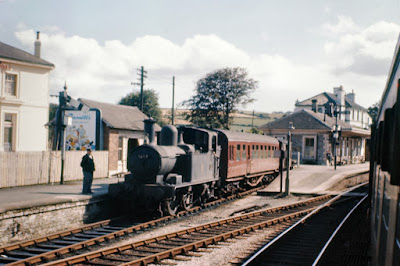
The Brixham train at Churston 1958 (copyright Mike Morant)
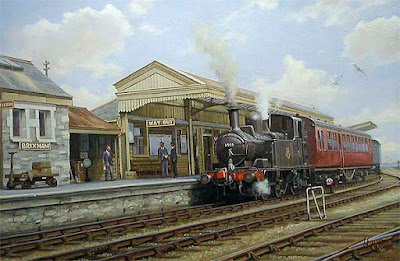
Brixham station in 1958 (painting by Mike Jeffries) 


When you visit the Dartmouth Steam Railway if you look to your left heading towards Kingswear you should be able to see that Churston station was a junction. This was the starting point for the short branch line to Brixham. You'll probably also be surprised that such a well known and picturesque town as Brixham is not on the rail network! 

The branch opened in 1868 and was originally broad gauge. It suffered one major problem in that Brixham station was situated on a hill above the town, so getting down to the good stuff was a bit of a steep walk, getting back up was worse! 

The line carried a lot of fish from boats in Brixham's busy harbour, and carried a lot of passengers in the short summer season. The inconvenient placing of the station coupled with a seasonal traffic flow were always going to be an issue, as was the need to change trains at Churston (and in most cases Paignton) to get anywhere up country. 

There was a small engine shed at Brixham, a wooden station and brick gentlemen's toilet. 

The line was converted to standard gauge in 1892. 

Auto trains served the line from the early 20th century almost to the end. DMUs operated from 1961 to 1963. These competed with bus services which began to take away a lot of the passengers as they were more convenient and dropped people in the heart of the town, rather than on top of a hill! Train services were halved in 1951 thanks to a national coal shortage and were never reinstated in full. 

The line closed completely on 13 May 1963 and lifted in about 1964. The station was used shortly after closure in the film 'The System'. 

 There has been some speculation on reopening the line, though the station site would still be an issue and rather than just cut and paste I've provided the link below - https://www.railmagazine.com/infrastructure/stations/reconnecting-brixham 

The Disused Stations site has a fine array of pictures and maps etc at http://www.disused-stations.org.uk/b/brixham/index.shtml 

Sunday, 5 July 2020

Devil's Dyke


Growing up in Littlehampton my nan's house faced a bus stop where some buses carried intriguing detination board for 'Devil's Dyke'. It seemed an impossibly romantic place but sadly well beyond our financial resources in the 1960s to visit! So I never made that bus trip which in the summer would have been on an open topped bus.

Later I discovered that Devil's Dyke also once had a railway running to it. This was even more tantalising. In the 70s I finally got to visit the Dyke, following the old railway up into the Downs after alighting at Aldrington Halt.

There were remains of the route throughout, once I got out of the suburban part. The Dyke itself was a bleak place, even on a summer's day, devoid of people or anything else apart from the farm that barred entry to the still existing Dyke station platform.

Delving into the history of the railway and the Dyke gave a fascinating insight into just how different Edwardian Sussex had been! For the Dyke Railway brought visitors up from Brighton and beyond to a whole range of attractions set hundreds of feet above the glittering coastline to the south.

The railway was opened on 1 September 1887' leaving the Portsmouth-Brighton line at what later became Aldrington Halt, climbing through the suburbs and on to the Downs. This was the only railway to climb the South Downs properly, other routes to the west tunneling through them instead. The route was approximately 3.5 miles long with an average gradient of 1 in 45.

The line's glory years were in Edwardian times (1901 to 1910), the First World War followed by an increase in motoring (no doubt including the precursor to that 31 bus that went past my nan's!) affected railway numbers, with the line closing completely on 31 December 1938.

As well as the railway there were two other unusual transport attractions at the top. There was a funicular railway down to Poynings which was 840 feet long with a gauge of 3 feet. It was called the Steep Grade Railway. This line opened on 24 July 1897. This was the only inland funicular passenger line in Sussex. It didn't last long, closing around ten years later.


There were many attractions at the Dyke including a hotel, amusements and a switchback railway (roller coaster). Many speculate that the Steep Grade Railway was closed because it was siphoning off trade from the Dyke's attractions to shops and pubs down in Poynings.

Another rail-like attraction was the Aerial Cableway, which spanned the Dyke itself. It was designed and built by William Brewer in 1894, it was made from 1,200 feet of cable, suspended  230 feet above the valley floor on cast metal supports.

It had two cars, each carrying just four passengers, which were pulled across the Dyke by a cable worked by an oil engine.


1902


Like the Steep Grade Railway its popularity was short-lived, opening on the 13th October 1894 and carrying its last passengers around 1909.

The Dyke Railway is an unusual example of a railway that depended purely on an ephemeral, once fashionable, desire for entertainment in strange places from our ancestors. The whole set up burned brightly for a few decades before all returning to dust and the normal bleak beauty of the high South Downs.

References http://www.urban75.org/railway/devils-dyke.html

                   https://www.mybrightonandhove.org.uk/places/placeland/devils-dyke/devils-dyke-5


Saturday, 25 April 2020

Bishops Waltham branch


1962 (Copyright Jim Lake).


1953 (Copyright John Aston)


A reminder (2015) (Sourced via Google)


Branch railmotor at Botley 1906


Durley Halt - a rare photo!


On our regular trips to Winchester to visit relatives in the 1960s and 1970s we normally went via Bishops Waltham, and there was an intriguing pair of old level crossing gates by a roundabout near the town centre.

Research revealed that these were a remnant of the branch line from Botley, on the Fareham to Eastleigh line, to Bishops Waltham. This line opened on 31 December 1863, closed early to passengers on 31 December 1932, and completely in 1962.

Following the course of the River Hamble for much of its route it was single track throughout and lightly engineered with just a few underbridges. There was a small halt at Durley (see pic above) which only opened in 1910 and only saw light traffic.

There were other rail proposals in the Bishops Waltham area which never saw the light of day (or at least not yet!) including a line to Petersfield and another to Alton. A further, later,  proposal was a route to Droxford on the Meon Valley route from Fareham to Alton.

Passenger and freight traffic was generally light, except in the strawberry season when there would be many special trains carrying the fruit to the markets in London.

Railmotors were used for a short time but lacked flexibility as they couldn't pull additional coaches.

A short section of line still exists at the Botley end. I remember walking this in about 1970, it was a real surprise to find it there. It was about 400 metres of so and overgrown with small trees in places! This section has since been restored as a siding for Foster Yeoman aggregate trains, and has even been doubled in recent times. The rest of the route beyond is basically intact but very overgrown in places.

There was a scheme to build a narrow gauge line along most of the route in 1964, but this didn't reach an advanced stage.

Sunday, 23 June 2019

Welsh short line!


Railway reminder at the waterfront.


153 333 at Cardiff Bay.


En route.


153 333 at Cardiff Queen Street.

(All pics copyright Steve Sainsbury/Rail Thing 21.6.2019


11th anniversary trip to Cardiff on Friday/Saturday. Wasn't supposed to be rail related in any way. But strange things happen. We wanted to go down to Cardiff Bay to see some of the sights. From the hotel it was about a mile. Half way down my wife started moaning 'This is boring, it's like Hartcliffe. I am NOT walking back!' I explained this was just the journey, not the destination, as we passed another cheap shop selling fags and lottery tickets.

But help was at hand. All the way down we'd been following a railway, being a bit out of my area I'd not much idea what it was, but we'd seen a few passenger trains running along it.

Turns out it was the Cardiff Bay branch, which used to be the Cardiff (Bute Street) branch which also connected this area of the docks to the network.

So train trip back it was! Cardiff Bay station reminded me a bit of those bus shelter type places so common in the 70s. Just a single line. A train came in quickly and we were soon trundling up the branch. It was a very short ride! Within about 4 minutes we were in the bay at Cardiff Queen Street station. So the train just shuttles up and down all day. Great service, busy and cheap.

Getting back to Bristol I did a little research. It seemed to me that the line would be so much better if it went the extra kilometre or so to the nice shops and restaurants at the water side. Also to the Welsh parliament (Senedd) and Welsh National Opera, both nearby.

Turns out that this is EXACTLY the plan. Within a few years the station at Cardiff Bay will close, the line will be extended towards the centre of the harbourside, an intermediate station will be built at Loudon Square and tram-trains will run every ten minutes on the line. It's great to see our branch lines being developed in the 21st century.


Saturday, 13 June 2015

Abingdon 1985


(All 30.5.1985 copyright Steve Sainsbury/Rail Thing)


On a sunny evening in 1985 I visited Abingon for the first and only time, and found the branch still in situ. Unfortunately the late evening light made photography quite challenging but I did get these six shots.

The line closed to passengers in 1963 robbing this busy town of a modern transport link, but the line stayed open to freight until the 1980s. I'm sure it was closed completely in 1985 when I took these photos, but I may well be wrong! I haven't yet found a date for complete closure.

As always you have to wonder why a town of this size lost its trains. Commuters would no doubt be very grateful for a rail service to London and beyond now. Perhaps many of these shorter branch lines will reopen as narrow gauge electrified routes in the future, though I'm sure many would work just as well as standard gauge lines, providing an essential link once roads are no longer an option.

More information (from Wikipedia)

History

The station was built by the Abingdon Railway, although this was operated by the Great Western Railway (GWR) from opening on 2 June 1856. The station and yard were built to the broad gauge on land acquired from the Mayor and Aldermen of the Borough of Abingdon on 19 March 1856 at a cost of £472. Seven properties were demolished to make way for the station and yard, including the Plough Inn which was subsequently rebuilt at a different location. The approach to the station from Stert Street had gates and no public right of way was allowed. Station facilities consisted of a single platform covered by a timber train shed.[1] A locomotive shed was built on land which was never formally conveyed to the railway, but later acquired by adverse possession.
The Abingdon Railway was absorbed by the GWR on 15 August 1904. The line passed on to the Western Region of British Railways on nationalisation in 1948, and was then closed to passengers by the British Railways Board in 1963. However the branch was used by freight, notably MG Cars, and the occasional passenger excursion, the last of which took place in June 1984.
The branch track was lifted in the late 1980s.