Showing posts with label East Grinstead. Show all posts

Monday, 31 October 2016

Sheffield Park 8 July 1977

SHEFFIELD PARK


(All pics 8.7.1977 copyright Steve Sainsbury/Rail Thing)


Almost 40 years have passed since I took these photos in July 1977 of the Bluebell Railway. Back then it was an all-steam line just 4 miles long, linking the country station of Sheffield Park to the extraordinary junction station at Horsted Keynes. Remarkably up until 14 years before these pics you could reach the Bluebell via the Southern Region's electrified branch from Haywards Heath to Horsted Keynes. It took the Bluebell another 50 years to reconnect with the network! But the line also owns the trackbed of the Haywards Heath line so at some point in the future the original Bluebell connection will be regained though, sadly, unlikely to be electrically operated! 

So back in 1977 the Bluebell was a very pleasant and self contained set up, with loads of classic steam locomotives and coaches and for those of us brought up in Sussex it was a fairly regular treat to travel on the line. There was hardly a house visible on the entire route and this section really showed the wonderful rural nature of the line. Stations were built on a grand scale for such a rural line, with the earthworks, bridges and tunnels built for double track, which was present between East Grinstead via Horsted Keynes to Haywards Heath. The section south of Horsted Keynes was always single track.

I've always felt that heritage lines tend to freeze time and old pics of them can almost be reproduced today, and that this static element makes them less interesting than network lines. But as time passes that's fading. It's true that the biggest clue to the age of this pics is the array of classic cars in the exterior shot of the station, but fashions etc also date a pic. As of course does the traction used - locos come and go, go out of ticket, become unuseable or get sold on. There is change on heritage lines after all!

Overall of course the Bluebell has changed enormously since the seventies. Freshfield Halt has closed for example, there are new stations at Kingscote and East Grinstead, with West Hoathly always a possibility in the future. The line is no longer all steam, and of course there are now excursions off the network, which bring all sorts of visitors to the line. Facilities have improved both front of house and behind the scenes. The little line has become big business, but you can still savour the lovely Sussex countryside from inside a vintage carriage - and see more of it now on the longer journey!

Friday, 22 July 2016

Tunbridge Wells Ghost

TUNBRIDGE WELLS WEST


(All 31.8.1988 Copyright Steve Sainsbury/The Rail Thing)


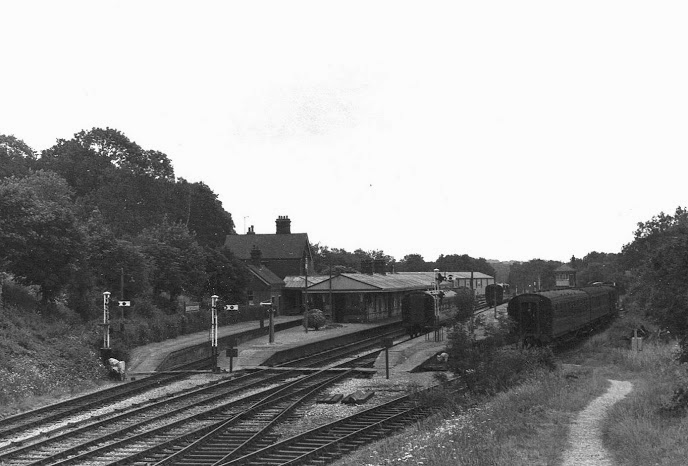
For a station and line that closed in 6 July 1985 it was something of a surprise to find that, just over three years later, the tracks were still down and the station and other buildings still standing. I suspect that this will be my last ever brush with the gothic glory of a large railway station entering decay, because they just don't close railways any more!

This was just about the last real railway closure in the UK. A few other short stretches of lines have closed since, but they have all found a new rail use, usually as a tramway. Indeed this line also has as well, but as a heritage line linking a new station at Tunbridge Wells with the Network station at Eridge. But back in 1988 this was all in the future, and the line had fallen into total disuse.

Amazingly the line closed for the sake of £175,000(!!!), the quoted cost of incorporating Grove Junction into the newly electrified Tonbridge to Hastings line. This short section through a tunnel just to the east of the West station remains disused, but is protected for future rail use.

The line saw diesel units for a while after closure, these were stabled at the depot there until new arrangements could be made. This meant the infrastructure stayed in place a little longer.

The Spa Valley Railway has gradually reopened the stretch back to Eridge where cross platform interchange is made with Network trains running up from Uckfield and down from Oxted and beyond. This gives the heritage line useful resilience and also the potential for future community traffic.

Looking further ahead it's likely that many other lines long disused in this area will reopen as the oil runs out and more and more traffic goes to the railways. This includes the iconic Cuckoo line which runs south from Eridge to Polegate near Eastbourne, the useful route from Eridge via East Grinstead to Three Bridges and, of course, the soon to be reopened Lewes-Uckfield line. Bearing all this in mind, plus the progress already made at the Spa Valley, these pics really do show the low point of Tunbridge Wells West's fortunes. I have mixed feelings - gratitude that I got to see this but perhaps regret that I didn't see it in its glory days - and will probably miss seeing the whole network reopen.

Sunday, 16 March 2014

The other Kent and East Sussex


Eridge 2.1.1973


1317 at Groombridge 4.7.1977


Tunbridge Wells West 31.8.1988 

(All pics copyright Steve Sainsbury/The Rail Thing)


By the mid 1980s railway closures were a fading memory, but in a last burst of misplaced nostalgia there was one final closure down south, when the useful (but not as useful as it will be!) route from Tunbridge Wells to Eridge was closed. The excuse was the expense of remodelling the junction at Tunbridge Wells when the main Hastings line was electrified ... and so another part of the network of lines in this area had to close.

The line was quickly resurrected as the Spa Valley Railway, but a few tourist trains hardly compensates for the loss of a seven day a week service. And that important link at Tunbridge Wells is STILL devoid of track.

I got to travel on this line a few times and it was a nice rural route. I must admit that by the 70s a lot of the line's purpose had gone. Once it had provided a gateway to lines to Brighton, Lewes, Eastbourne, East Grinstead and Three Bridges, offering a huge range of trips and keeping a good bit of traffic off the roads. It also made commuting an easy proposition in a whole swathe of this region. By 1985 it really just provided a link between Tunbridge Wells and Uckfield (Lewes no longer being an option) and also allowed people in the West of Tunbridge Wells to access the Network (and London) via the large and gothic station at Tunbridge Wells West.

So the line was closed, the last real closure of any substance in southern England and possibly the whole country. A final fling for Beeching and his empty headed accountant hordes.

But things are stirring. As mentioned above a good stretch of the line is now a tourist railway, but the Lewes-Uckfield line is on the cusp of reopening, there are murmurs about the useful 'Cuckoo' line to Eastbourne and the East Grinstead line now has a group working with banks and others in the area to reopen this useful link (at least for a few more decades) to Gatwick Airport and, more importantly, the Brighton main line. East Grinstead of course has had it's other line (to Sheffield Park) reopened last year, and the Bluebell have a 25 year and beyond plan that mentions a possible return to Lewes. The whole area will be transformed for rail.


Withyham 4.7.1977

Still in deep sleep the useful route from Eridge via East Grinstead to Three Bridges is beginning to stir again.

Sunday, 16 February 2014

bluebell branches out


(Photos copyright Steve Sainsbury/Rail Thing) 


I grew up in Sussex and the Bluebell was a constant presence to me. Loads of people talked about it, everyone I knew visited it and I got to go every year or so. I even joined and volunteered and spent one frosty day working on the track, but back then my only way of getting there was to go to Haywards Heath and walk or go by motorbike.

Back then of course it was a lovely, rural four mile long classic branch line, but things have changed a lot since then! I have done the extension to Kingscote but yet to do the East Grinstead stretch, but I have my eyes on a Steam Tours trip from Alresford to Sheffield Park in October!

The Bluebell has always been rather ahead of the game and have cleverly built their Network connection before oil supplies get tight, which will allow them to continue to bring in visitors and volunteers long after cars are just a fading memory.

And less than a year after making that Network link they are talking about their second! They have owned much of the Ardingly branch for years. Now with East Grinstead reached they can start to redirect their energies towards Haywards Heath.

The Haywards Heath-Ardingly-Horsted Keynes route was always an odd one. It was electrified for a start! It also had a very odd destination - the huge former junction station of Horsted Keynes stuck in the middle of nowhere. No doubt it survived the closure of the main line from Lewes to East Grinstead because it was electrified, but it did eventually close in 1963, leaving the Bluebell isolated from the Network. Most of the line remained open for freight, and is still used by one stone train a day.

Bluebell's plans are to extend to Ardingly first, and then enter into a running rights agreement with the Network to allow them to reach the main line at Haywards Heath. Fortunately the Ardingly route has a separate line into Haywards Heath and there is room for a separate Bluebell station alongside the Network station. Land for this is already being looked at.

The Bluebell is estimating ten years (ie 2024) for this to be completed. When rebuilt this route will give an emergency Brighton-London route, and will also tap dkirectly into the south coast's large population of residents and holidaymakers.

There have been calls to make this route third rail electric, which would be fantastic, but there are health and safety issues, apparently. (Though surely this would apply to the whole Network??) I would love to see the units I grew up with on the south coast running in preservation. We shall see.

And after Haywards Heath is reached? I suspect that the Bluebell will at last start to look south of Sheffield Park, and rebuild that little lost stretch to Lewes. This will increase the flexibility and resilience of their network and will tap directly into traffic from Lewes, Eastbourne and that whole area of East Sussex. It will also create yet another possible diversionary route for the BML.

From a schoolboy's crazy dream in the 1950s to an embryonic network covering a big slice of rural East Sussex, the Bluebell is a magnificent example of the possible and should inspire all of us!


Barcombe 4.7.1977 (copyright Steve Sainsbury/Rail Thing) - the final piece of the jigsaw!

Friday, 14 October 2011

East Grinstead. 1977

(All 1.8.1977)

East Grinstead will soon have trains to the south again once the Bluebell Railway finally gets through Imberhorne. Back in 1977 the dream of steam returning to East Grinstead would have been an impossible one, which just shows how much progress has been made in the last 34 years!

Of course back in 1977 rail was on the defensive, you couldn't even be sure that East Grinstead would survive, beoing on a dieselised and truncated route. Once East Grinstead had lines to all four points of the compass, by 1977 you could only go north. Soon you'll be able to head south again, and no doubt eventually east and west as well as the Three Bridges to Eridge route returns to the map. The 1967 closure of the route which gave access to Gatwick Airport and Tunbridge Wells was particularly short sighted!

East Grinstead originally had both an upper and lower station - the lower station is the one that survives. Hopefully future developments will allow all trains to use this lower station to make interchange easier.

Once trains start to operate southwards of East Grinstead how long before the pressure builds on the Bluebell to restore the Sheffield Park to Lewes line? This would give the Bluebell a genuine purpose again as well as allow it to tap into tourist traffic from Brighton and Eastbourne. Okay, so today a lot of people visit the line by car or bus, but these options will disappear altogether over the next few decades. And with the Bluebell also owning the Ardingly route they are setting themselves up nicely for THREE eventual Network connections, surely assuring them of a future role in an energy constrained world?