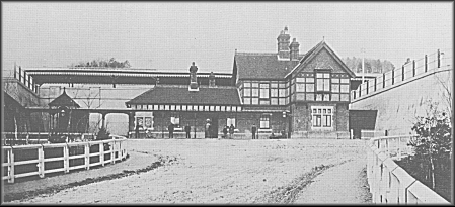
LAVANT

(Lavant 24.6.1976 Copyright Steve Sainsbury/Rail Thing)

(Lavant 15.5.1977. Copyright Steve Sainsbury/Rail Thing)
Imagine a single track railway with impressive tile hung stations running through a National Park linking a cathedral city with a country town, using exclusively steam - over bridges and through tunnels cutting through the South Downs.
Not quite the Bluebell or Cuckoo lines - the line was the Chichester to Midhurst branch of the LBSCR. The line closed throughout to passengers as long ago (as did Chichester's other branch line) but kept going with freight traffic throughgout until 1951 when flooding led to an accident which effectively cut the line between Cocking and Midhurst. Most of the remainder of the line closed in 1953, apart from the two mile section to Lavant which remained open until 1970 for seasonal sugarbeet traffic. An even shorter section of the line opened as far as a gravel pit south of Lavant, this final section closing as late as 1991.

(Near Lavant 15.5.1977. Copyright Steve Sainsbury/Rail Thing)
These are the basic facts about this line, but I had a much closer attachment to the route, as back in the late 60s and early 70s it was the closest disused line to where I lived in Littlehampton, and I regularly visited the line at Lavant, just catching it whilst the track was still down. The track ran through the station and tantalising beyond northwards to vanish in long grass with the South Downs as a backdrop. So a regular trip for me in that period was to catch the train from Littlehampton to Chichester, then walk until I could pick up the track south of Lavant.
The line beyond was a mystery to me and I never ventured beyond Lavant in those days. But a few years later I had a motorbike and followed the route northwards. I did get to photograph Cocking station, but Singleton was too scary to approach with it being a working vineyard (a rare thing even in Sussex back in pre-Global Warming days!)

(Cocking 24.6.1976 Copyright Steve Sainsbury/Rail Thing)
I had even been lucky enough to see the closed LBSCR station at Midhurst which marked the northern end of this route back in about 1970, shortly before it was demolished and a year before I started taking pictures. I even found the long abandoned LSWR in Midhurst on the same day which hadn't seen trains stop since 1925 (?) when all services began to use the more imposing LBSCR station.

(Midhurst LBSCR 1958. Source Google)
I haven't been back to this line for many years. The trackbed is now a cycleway and footpath and the station at Lavant has been converted into flats (it was a very big station for a small village!) Singleton is still a vineyard and Cocking is an impressive private house. You'd hardly know Midhurst ever had a station let alone two.
The future? Well Midhurst will need trains again one day, that's for sure. There were three branches to Midhurst, from Chichester, Pulborough and Petersfield. But the most useful line never actually got built - a direct route to London via Fernhurst and the Portsmouth Direct route ...
There have been schemes over the years to reopen at least part of the Midhurst network, albeit as a heritage line. One thing's for sure, no railway ever really dies, and they are all just waiting for their time to come.