YORK
A quick snatched selection of pics that I took close to York station back in 1986. I suspect most of the equipment - locos and stock - have now vanished.
These shots do underline the sheer variety there was on the Network even before sectorisation or privatisation with freight, express and local passenger services all passing me in the few minutes I was here.
These were taken in my lorry driving days (I'd probably just delivered to the works at York) and the job gave me the chance of visiting many locations around the country. Shame it was before digital or I'd have doubtless taken many, many more!
More info (from Wikipedia)
Despite the small size of the city, York is one of the most important railway stations on the British railway network because of its role as a key railway junction approximately halfway between London, the capital of England, and
Edinburgh, the capital of
Scotland. It is few miles north of the point where the
Cross Country and
First TransPennine Express routes via
Leeds leave/join the ECML connecting
Scotland and the
North East with
southern England, the
North West and the
Midlands. The junction was historically a major site for rolling stock manufacture, maintenance and repair.
History
The first York railway station was a temporary wooden building on Queen Street outside the
walls of the city, opened in 1839 by the
York and North Midland Railway. It was succeeded in 1841, inside the walls, by what is now
York old railway station. In due course, the irksome requirement that through trains between London and Newcastle needed to reverse out of the old York station to continue their journey necessitated the construction of a new through station outside the walls. This was the present station, designed by the
North Eastern Railway architects
Thomas Prosser and William Peachey, which opened in 1877. It had 13 platforms and was at that time the largest station in the world. As part of the new station project, the Royal Station Hotel (now
The Royal York Hotel), designed by Peachey, opened in 1878.
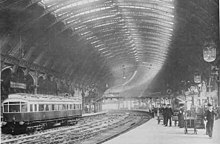
York station in the early 20th Century
In 1909 new platforms were added, and in 1938 the current footbridge was built and the station resignalled.
The building was heavily bombed during the Second World War. On one occasion, on 29 April 1942, 800 passengers had to be evacuated from a Kings Cross-Edinburgh train which arrived during a bombing raid. On the same night, two railway workers were killed, one being station foreman William Milner (born 1900[2]), who died after returning to his burning office to collect his first aid kit. He was posthumously awarded the King's commendation for gallantry. A plaque in his memory has been erected at the station. The station was extensively repaired in 1947.
The track layout through and around the station was remodelled again in 1988 as part of the resignalling scheme that was carried out prior to the
electrification of the ECML shortly afterwards. This resulted in several bay platforms (mainly on the eastern side) being taken out of service and the track to them removed. At the same time a new signalling centre (
York IECC) was commissioned on the western side of the station to control the new layout and also take over the function of several other signal boxes on the main line. The IECC here now supervises the main line from Temple Hirst (near Doncaster) through to
Northallerton, along with sections of the various routes branching from it. It has also (since 2001–2) taken over responsibility for the control area of the former power box at
Leeds and thus signals trains as far away as
Gargrave and
Morley.
In 2006–7, to improve facilities for bus, taxi and car users as well as pedestrians and cyclists, the approaches to the station were reorganised. The former motive power depot and goods station now house the
National Railway Museum.
Accidents and incidents
- On 31 March 1920, a passenger train was derailed as it entered platform 8.
- On 5 August 1958, a passenger train crashed into the buffers at platform 12.
Layout
All the platforms except 9, 10 and 11 are under the large, curved, glass and iron roof. They are accessed via a long footbridge (which also connects to the
National Railway Museum) or via lifts and either of two pedestrian tunnels. Between April 1984 and 2011 the old tea rooms housed the
Rail Riders World/York Model Railway exhibition.
Major renovation
The station was renovated in 2009. Platform 9 has been reconstructed and extensive lighting alterations were put in place. New automated
ticket gates (similar to those in
Leeds) were planned, but the City of York Council wished to avoid spoiling the historic nature of the station. The then operator National Express East Coast planned to appeal the decision but the plans were scrapped altogether upon handover to East Coast.
Recent developments
The southern side of the station has been given new track and signalling systems. An additional line and new junction was completed in early 2011. This work has helped take away one of the bottlenecks on the East Coast Main Line.
The station has also become the site of one of Network Rail's modern Rail Operations Centres, which opened in September 2014 on land to the west of the station This t.ook over the functions of the former IECC in January 2015 and will eventually control much of the East Coast Main Line from London to the Scottish border and various subsidiary routes across the North East, Lincolnshire and South, North & West Yorkshire.
Platforms

South-facing station approach
The platforms at York have been renumbered several times, the current use is:
- Platform 1: South-facing bay platform mostly used for services to Hull and for stabling empty stock.
- Platform 2: North-facing bay platform connected only to the Scarborough branch, used mostly for stabling a spare First TransPennine Express unit (along with the accompanying station siding).
- Platform 3: Main southbound platform (but is signalled bi-directionally), accessible directly from the station concourse. Fast and semi-fast southbound Virgin Trains East Coast for London King's Cross generally use this platform. Also, CrossCountry services, Grand Central and some westbound First Trans-Pennine Express services also use it.
- Platform 4: Northward continuation of platform 3 connected only to the Scarborough branch, used by First Trans-Pennine Express services from Scarborough.
- Platform 5: (Split into 5a and 5b) Main northbound platform (but is signalled bi-directionally). Fast northbound Virgin Trains East Coast services to Scotland use this and generally call at Darlington and Newcastle Central only. Accessible by footbridge or tunnel. Also used by some CrossCountry services northbound. North/eastbound First Trans-Pennine Express to Scarborough generally use this platform along with summer Saturday-only East Midlands Trains services to Scarborough. Southbound Virgin Trains East Coast services also stop here both fast and semi-fast, the latter of which generally call at Doncaster, Newark, Peterborough and London King's Cross.
- Platform 6: South-facing bay platform used mostly by Northern Rail commuter services and by terminating Virgin Trains East Coast services that return south to London King's Cross, and on non-summer Saturdays by East Midlands Trains services to London St. Pancras.
- Platform 7: South-facing bay platform used mostly by Northern Rail commuter services, Virgin Trains East Coast services to/from London King's Cross starting/terminating at York, and non-summer Saturday services by East Midlands Trains to London St. Pancras.
- Platform 8: North-facing bay platform used almost exclusively by Northern Rail trains on the Harrogate Line.
- Platforms 9, 10, 11: Bi-directional platforms used by semi-fast Virgin Trains East Coast services heading north to Newcastle and Scotland (but also some fast services), CrossCountry services north and southbound via Leeds, First TransPennine Express services westbound to Manchester Piccadilly, Manchester Airport and northbound to Newcastle Central and Middlesbrough. Some Northern Rail services to Blackpool also use this platform.
Platforms 10 and 11 exist outside the main body of the station. Another siding (the former fruit dock) exists opposite Platform 11.
Services

York railway station from the air

The arched roof over the platforms
Virgin Trains East Coast
Virgin Trains East Coast operates to London as well as many services northbound to Newcastle and Edinburgh. In addition, there are infrequent services to
Glasgow,
Aberdeen and
Inverness. The fastest southbound services run non-stop to London, completing the 188 mile journey in 1 hour and 52 minutes.
CrossCountry
East Midlands Trains
First TransPennine Express
Grand Central
Northern Rail


