Friday, 24 October 2014

Clarens-Chailly-Blonay


CCB Clarens Gambetta


CCB Ce 2/2 3 in Clarens. 1951


CCB Clarens-CFF. 1955


CCB Ce 2/2  1 at  Clarens-CFF. 1955 Photo  E. Gfeller


Clarens CFF 1955


CCB Chailly.  1950


CCB Fontanivent 1950
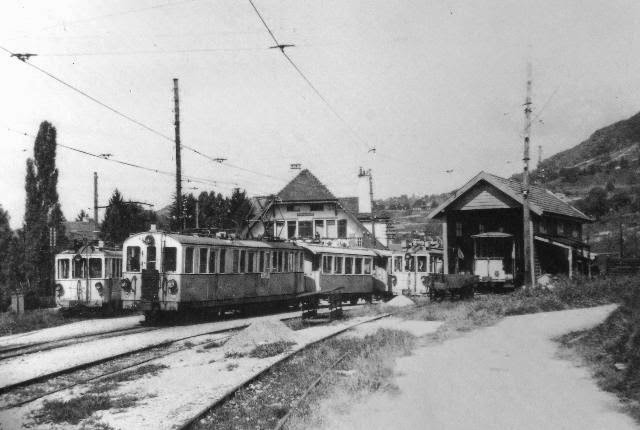

CCB Fontanivent 1950


CCB Fontaivent 1952


CCB Fontanivent 1955


CCB Fontanivent trackbed


CCB Last piece of track Fontanivent


CCB Blonay 1955


FACEBOOK - SWISS NARROW GAUGE RAILWAYS AND TRAMWAYS

The book that got me into Swiss railways and tramways was Cecil J Allen's Switzerland's Amazing Railways, I think I had the first edition which included maps across the covers. I was amazed by the network of lines around Lake Geneva and was disappointed to discover that many of them had closed by the time I visited Switzerland in 1976 - although just as many, if not more, remained open. There seemed to be a particularly dense network around Vevey and Montreux, and most of my stays in Switzerland (probably over 50 now!) have been in the mountains above these lakeside towns.

So although I was aware of these lines it's been a nightmare trying to find any information or photos of them - until yesterday when I discovered this fantastic website! So a bit of translation and photo choosing has led to this, the first of what I expect to be many articles on Swiss closed lines!

I am always more than happy to add more information and photos (fully acknowledged of course) including pictures of any remains of the lines or rolling stock, memorabilia etc. Also if you have any other information sources (any language) I would love to see them!

History

The CF Clarens-Chailly-Blonay connected the coastal town of Clarens with stations at Fontanivent and Blonay on the Montreux-Oberland-Bernoise line (MOB).  The line was metre gauge and opened from Clarens Pl. Gambetta to Blonay on 23.11.1911 and from Clarens Pl. Gambetta to Schiffstation on 4.07.1915. Maintenance of equipment and rolling stock was undertaken by the MOB. The short section from Clarens Pl. Gambetta - Schiffstation on 31.10.1943 and the remainder of the line on 31.12.1955. A VMCV bus route replaced the tramway. The line was just 5.6km long, 3.5km on street.

Route

From the landing stage at Clarens the VMCV (Vevey-Montreux-Chillon-Villeneuve) tracks were reached immediately and these were used as far as Place Gambetta. From here the tracks left the vMCV and headed north steeply towards Blonay. The tracks passed under the SBB via an underpass and on to Tavel, continuing to Chailly. Here the tracks turned eastwards, went through vineyards then joined the route of the MOB. The tracks of both lines then paralleled each other to Fontanivent. From here street tracks to the trams to Brent and Blonay, where the CCB had its own station, close to but separate from the MOB station.


Stations

Station/halt Distance   Height asl (m)

Clarens Lac     0,0            378  
Clarens Gambetta     0,2            382  
Clarens SBB     0,5            402  
Tavel     0,9            423  
Chailly     1,9            474  
Fontanivent  (MOB) 3,5            555
Brent     4,0            566  
Blonay     5,6            620

Rolling stock

Tramcars

type no            year suppliers

Ce 2/2 1 1911 SIG/MFO
Ce 2/2 2 1911 SIG/MFO
Ce 2/2 3 1911 SIG/MFO

passenger cars

type no         year         suppliers

C 11 1896 SIG
C 12 1896 SIG
C 14 1896 SIG

freight wagons

type no model year          suppliers

M 1 2 2 1913 ACMV
M 2 2 2 1913 ACMV

Remains

A tiny section of track remains at Fontanivent used by the MOB as a siding. There is also a short tunnel at Fontanivent, sealed at one end, together with the tunnel under the MOB. Much of the rest has disappeared as it ran on street.

Source

http://www.eingestellte-bahnen.ch/636/19785.html

Tuesday, 14 October 2014

singleton


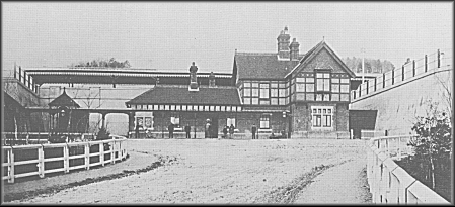
Before opening.


The subway in 2002.

(Copyright Chris Bedford Dumpman Films)


How it is now.


Nestling in a gap in the South Downs a few miles north of Chichester is one of the most fascinating closed stations of all.

Singleton's a small, fairly quiet village, but it holds a secret! A big closed station, now masquerading as a vineyard. 

If you're driving up from Chichester there's a clue as to why Singelton had such a big station Goodwood Race Course, which sits high on the Downs to the east of the village.

Singleton was on the Chichester to Midhurst line, opened in 1881. Traffic was always fairly sparse, but Singleton was different. It was designed as the station for Goodwood. It had four platforms connected by a subway, buffets, holding sidings for trains, a large goods shed and TWO signalboxes!  Whilst popular with King Edward VII the hoi polloi preferred Chichester station as the walk to Goodwood was easier!

Other stations on the line were far more basic with single platforms, but all sported elegant tile hung buildings in a similar style to those on the Bluebell and Cuckoo lines. Passenger trains finished in 1935, freight on this section continued to 1953 and the final section (south of Lavant) lost its trains in the late 1980s.

But the stations are still there (apart from Midhurst) although serving very different purposes these days. I never had the guts to sneak into Singleton and take pictures unfortunately, but Lavant was a regular haunt for me in the early 1970s. This was a fantastic line cutting as it did through the Downs. Hopefully it will return in the future.

Film of the route (plus loads of other great Sussex stuff!!)

More info (via Wikipedia) 

Singleton railway station served the village of Singleton in the county of West Sussex in England. The station was on the former line between Chichester and Midhurst. It was opened on 11 July 1881.
The station, designed by T. H. Myres, was built in a grand way by its owners the London Brighton and South Coast Railway, which included four platforms, with a subway linking them and the 'Country House' style station building, buffets, long sidings for awaiting trains, a large goods shed for dealing with freight, and two signal boxes to control the station. The main reason for this large building was to deal with visitors to the Goodwood Racecourse, but passengers preferred to use Chichester Station mostly due to the walk uphill to the course from Singleton. It was one of the most visited stations by the LBSCR Royal train as the prince of Wales (later Edward VII) used to 'weekend' with the James family at West Dean House. Little other traffic was ever found, and despite all of the grand hopes, passenger services were withdrawn on 6 July 1935. Freight services remained until these were withdrawn on 28 August 1953 by British Railways. The station is now in use by a vineyard owner.

Tuesday, 23 September 2014

trains at the pub


(All 24.4.2011 - copyright Steve Sainsbury/Rail Thing)


Until a few years ago the Hunter's Rest pub near Clutton had an attraction almost unique in the UK, if not the world - its very own miniature railway!

We visited just the once, planning to make it a regular trip. But sadly a short while after the one trip the line was suddenly closed. No idea why, perhaps the pub changed hands, there were insurance issues or they found a busier site.

But I did manage to get some photos on the day and caught it in the sun with trains running. No steam sadly, but at least I have the evidence that it did exist and it wasn't just some weird half remembered dream!

Thursday, 18 September 2014

by train in the road to the airfield


Copyright John McIvor


In the street!


I first heard about the RAE railway at Farnborough from an old Railway Magazine, typically a few years after it had closed. It seemed almost mythical as there were no photos to hand back then. A steam loco pulling a few wagons down a suburban street as late as 1968? Seemed unlikely.

Nowadays with the help of the internet it's been a little easier to get info and pictures, though they are still pretty rare! The line ran from Farnborough station goods yard for about a mile to the RAE establishment (still famous for its annual air show). As you can see from the photos it had a fair stretch of real street running. As late as 1967 you could have followed the steam train up the street to the station, then watched steam expresses roaring through.

Street running isn't quite as rare as we sometimes think. Everyone knows the Weymouth Tramway of course, but a fair few towns had industrial lines that used street running for short distances, especially in dock areas. I'm still finding out about new ones most weeks. We do of course still have a street running line in Bristol, which still uses steam.


Video!!


Saturday, 13 September 2014

on the frontline


Dawlish 50 021 10.9.1984


Dawlish 47 353 10.9.1984


Dawlish 10.9.1984


2.9.2014


2.9.2014


4.9.2014


4.9.2014


4.9.2014


143 621 4.9.2014


Dawlish Warren 10.9.1984 


31.8.2014


Dawlish Warren 10.9.1984


I took my first ever railway photo (indeed photo of any kind!) at Dawlish 
Warren on 9 July 1971. We were staying at Warren Sands campsite just along the way and the railway was an inevitable draw to a 14 year old with the beginnings of an interest in railways. I've been back a few times since on day trips, but got to spend a whole week there last week.

The line has been in the news recently and it certainly has an atmosphere of being in the front line in the coming 'war' against us and climate change. There are now strong moves to get a diversionary route or two in place in an attempt to avoid a repeat of the disgrace of last winter's inevitable six week closure.

I think we all need to visit this line as much as we can and record it in all its moods. It's now probably the only railway in the UK that may close in the future. That would be a tragedy.

We're planning to buy a caravan in Dawlish Warren (safely up on high ground and well away from any cliff edges of course) in 2016. My plan is to visit regularly and record the last decades of this line. 

My first railway interest was stirred by the Gothic remains of recently closed railways in Sussex - Fittleworth, Bramber, Lavant. And then I got deeper in, visiting the Selsey Tramway and others. Holidays took me further afield and I got to see lines in their last years - Kingswear, Okehampton, Yarmouth to Lowestoft. Dawlish was an eye-opener, an interesting (and open!) main line! Of course in the 70s it was Westerns and Peaks and class 47s, with first generation DMUs filling the gaps, plenty of freight etc. There were even still semaphore signals, and the line was haunted by the recent passing of steam, exemplified by the postcards being sold at Dawlish Warren, many of them featuring classic steam on the sea wall.

Steam has now returned of course, and we got to see the double headed Atlantic Coast Express on the sea wall. Most of the rest of the trains seemed rather dull with the occasional HST adding a touch of flair and history, and an image of the future, amongst the Voyagers and modern DMUs.

So expect a lot more from me on this stunning line over the coming years (and the next few days).

Tuesday, 26 August 2014

Tavistock Ho!


(Bere Alston 29.8.1972 copyright Steve Sainsbury/Rail Thing)


News just in is that the Bere Alston to Tavistock line will now be rebuilt. ('And about time'!) I suspect most of you are thinking.

Take a look at the rather dire picture illustrating this piece. I'd only just passed 16 and had only been taking photos for a year is my excuse, but in a way it captures everything about this line. It was a snatched shot taken from the Gunnislake train as it reversed at the station. There are a few passengers on the platform, which shows that even in the nadir of rail travel in the UK this line was still fairly well used.

There's a very evocative final paragraph in the seminal work on these routes - The Withered Arm by T E Roche. The book had described this network of routes, and the sense of shock that a MAIN line could be closed. The author takes a little walk beyond Bere Alston, just a short while after closure, and almost talks himself into believing the line is still open, because the exit to the north is on a curve (as can be seen in the photo above) and nothing seems to have changed. And then he suddenly chances upon the buffers and stares in disbelief at the empty trackbed beyond.

Like the Waverley route the main SR route to Plymouth once boasted a network of branches off it, and these all needed to be closed before the final axe could be yielded. But the Callington branch was different, road services could NEVER replace the trains because of the way the Tamar cut a meandering course, isolating village en route from easy road access. So the line remained, though spitefully the last few miles from Gunnislake to Callington WERE closed. What it meant was that a good few miles of the old main line, from which the Gunnislake line branched off also had to be kept open. Six miles north of Bere Alston was the large and important town of Tavistock, which once boasted two stations, but this short piece of the line also had to close, so fanatical were the axemen of the time. Further on, at Meldon Viaduct, the main line reappeared, freight for a few miles, then Okehampton was allowed a passenger service - but even this was closed (to passengers) in 1972. I was there a few weeks before this stretch of line also closed to passengers, approached from Exeter of course. Freight kept going, and in recent years passenger services have been reintroduced on a few days a year. The line lives on here as well, if currently truncated!

Of course back in 1972 many people seriously believed the railways were finished, a withering rump remaining for those too poor to afford cars. Things have changed completely now, with rail in the ascendent and busier than it's been for almost a hundred years. We feel sorry for those people that are still tied to their cars, and now it's roads that are in decline (terminal this time).

Yet we're stuck with a fragmented rail network, designed for a world that's gone, and we need to get our railways back as quickly as we can, before the roads fail completely. There is the additional problem of climate change or, as it's now being rebranded, climate chaos. We all saw the terrible scenes at Dawlish last winter, when we were hit by ten storms in three months thanks to the stuck jetstream, directly caused by rapidly rising temperatures over the Arctic. We may find that many future winters are as extreme or more so, coupled with rapidly rising sea levels this spells the slow end of the 'alternative' route between Exeter and Plymouth via Dawlish, and the rapid rise of the Okehampton 'alternative'. Whilst we may get away with closing the ONLY route to Torbay, Plymouth and resurgent Kernow for now, and for a few weeks, that won't be acceptable in years to come when the road option is no longer available.

This is the REAL agenda behind the reopening of Tavistock. It may be dressed differently for public consumption, but I think we all know what this is really about. With Tavistock back on the network that gap to Meldon will seem tiny - smaller than the Borders Railway that will reopen next year for example (and through more challenging terrain!) Within a few years no doubt a solid and financed plan to close the link and give the west a second route to Plymouth, Torbay and Kernow will emerge. 

But this is just one reopening. To build resilience and keep our economy moving as the oil age ends we'll need a thousand .....


Monday, 18 August 2014

Rails Around Chichester


(All copyright Steve Sainsbury/Rail Thing, 15.8.2014)

We had a big family wedding last weekend, all centred around Chichester cathedral. I managed to wangle a quick trip to the station and took the photos above.

This whole area is where I grew up and many of my early photos were taken on the Coastway line between Brighton and Portsmouth. I often visited Chichester to walk up the old Midhurst line to Lavant and down the old Selsey Tramway to Hunston. I first visited Lavant in 1971, just a year after the regular sugar beet trains finished, but I do remember track at the station and beyond, where a buffer stop in the long grass marked the end of the Midhurst line. As the years passed the track was lifted as trains only ran as far as the gravel works near Brandy Hole Lane. Eventually even this short stub closed and the track was lifted - when I moved to Bosham around 2000 the line had gone. 


(Both Chichester station 21.8.1986 copyright Steve Sainsbury/Rail Thing)


Lavant 24.6.1976


Above both 15.5.1977 - top shot shows the end of the line by Brandy Hole Bridge. The lower picture shows Lavant, now trackless of course. I never got to photograph the track in situ here.


The other branch from Chichester was the Selsey Tramway, a Colonel Stephens' line, and often claimed to be the most ramshackle of them all, which is saying something! The top shot must be very near the line's opening, or possibly the opening day itself, when the line took delivery of  its lovely new carriages. The bottom shot is more typical, with one of the petrol railcars waiting for passengers. Both lines from Chichester closed to passengers in 1935. There are often rumblings in the city and Selsey for the tramway to be reopened, it would be a most useful (and cheap to run) line today. The line north to Midhurst would be a spectacular 'heritage' line, cutting as it does through the South Downs and serving the racecourse at Goodwood. It may well be that both lines reopen in the coming decades, and Chichester regains its status as a junction.