Tuesday, 26 August 2014

Tavistock Ho!


(Bere Alston 29.8.1972 copyright Steve Sainsbury/Rail Thing)


News just in is that the Bere Alston to Tavistock line will now be rebuilt. ('And about time'!) I suspect most of you are thinking.

Take a look at the rather dire picture illustrating this piece. I'd only just passed 16 and had only been taking photos for a year is my excuse, but in a way it captures everything about this line. It was a snatched shot taken from the Gunnislake train as it reversed at the station. There are a few passengers on the platform, which shows that even in the nadir of rail travel in the UK this line was still fairly well used.

There's a very evocative final paragraph in the seminal work on these routes - The Withered Arm by T E Roche. The book had described this network of routes, and the sense of shock that a MAIN line could be closed. The author takes a little walk beyond Bere Alston, just a short while after closure, and almost talks himself into believing the line is still open, because the exit to the north is on a curve (as can be seen in the photo above) and nothing seems to have changed. And then he suddenly chances upon the buffers and stares in disbelief at the empty trackbed beyond.

Like the Waverley route the main SR route to Plymouth once boasted a network of branches off it, and these all needed to be closed before the final axe could be yielded. But the Callington branch was different, road services could NEVER replace the trains because of the way the Tamar cut a meandering course, isolating village en route from easy road access. So the line remained, though spitefully the last few miles from Gunnislake to Callington WERE closed. What it meant was that a good few miles of the old main line, from which the Gunnislake line branched off also had to be kept open. Six miles north of Bere Alston was the large and important town of Tavistock, which once boasted two stations, but this short piece of the line also had to close, so fanatical were the axemen of the time. Further on, at Meldon Viaduct, the main line reappeared, freight for a few miles, then Okehampton was allowed a passenger service - but even this was closed (to passengers) in 1972. I was there a few weeks before this stretch of line also closed to passengers, approached from Exeter of course. Freight kept going, and in recent years passenger services have been reintroduced on a few days a year. The line lives on here as well, if currently truncated!

Of course back in 1972 many people seriously believed the railways were finished, a withering rump remaining for those too poor to afford cars. Things have changed completely now, with rail in the ascendent and busier than it's been for almost a hundred years. We feel sorry for those people that are still tied to their cars, and now it's roads that are in decline (terminal this time).

Yet we're stuck with a fragmented rail network, designed for a world that's gone, and we need to get our railways back as quickly as we can, before the roads fail completely. There is the additional problem of climate change or, as it's now being rebranded, climate chaos. We all saw the terrible scenes at Dawlish last winter, when we were hit by ten storms in three months thanks to the stuck jetstream, directly caused by rapidly rising temperatures over the Arctic. We may find that many future winters are as extreme or more so, coupled with rapidly rising sea levels this spells the slow end of the 'alternative' route between Exeter and Plymouth via Dawlish, and the rapid rise of the Okehampton 'alternative'. Whilst we may get away with closing the ONLY route to Torbay, Plymouth and resurgent Kernow for now, and for a few weeks, that won't be acceptable in years to come when the road option is no longer available.

This is the REAL agenda behind the reopening of Tavistock. It may be dressed differently for public consumption, but I think we all know what this is really about. With Tavistock back on the network that gap to Meldon will seem tiny - smaller than the Borders Railway that will reopen next year for example (and through more challenging terrain!) Within a few years no doubt a solid and financed plan to close the link and give the west a second route to Plymouth, Torbay and Kernow will emerge. 

But this is just one reopening. To build resilience and keep our economy moving as the oil age ends we'll need a thousand .....


Monday, 18 August 2014

Rails Around Chichester


(All copyright Steve Sainsbury/Rail Thing, 15.8.2014)

We had a big family wedding last weekend, all centred around Chichester cathedral. I managed to wangle a quick trip to the station and took the photos above.

This whole area is where I grew up and many of my early photos were taken on the Coastway line between Brighton and Portsmouth. I often visited Chichester to walk up the old Midhurst line to Lavant and down the old Selsey Tramway to Hunston. I first visited Lavant in 1971, just a year after the regular sugar beet trains finished, but I do remember track at the station and beyond, where a buffer stop in the long grass marked the end of the Midhurst line. As the years passed the track was lifted as trains only ran as far as the gravel works near Brandy Hole Lane. Eventually even this short stub closed and the track was lifted - when I moved to Bosham around 2000 the line had gone. 


(Both Chichester station 21.8.1986 copyright Steve Sainsbury/Rail Thing)


Lavant 24.6.1976


Above both 15.5.1977 - top shot shows the end of the line by Brandy Hole Bridge. The lower picture shows Lavant, now trackless of course. I never got to photograph the track in situ here.


The other branch from Chichester was the Selsey Tramway, a Colonel Stephens' line, and often claimed to be the most ramshackle of them all, which is saying something! The top shot must be very near the line's opening, or possibly the opening day itself, when the line took delivery of  its lovely new carriages. The bottom shot is more typical, with one of the petrol railcars waiting for passengers. Both lines from Chichester closed to passengers in 1935. There are often rumblings in the city and Selsey for the tramway to be reopened, it would be a most useful (and cheap to run) line today. The line north to Midhurst would be a spectacular 'heritage' line, cutting as it does through the South Downs and serving the racecourse at Goodwood. It may well be that both lines reopen in the coming decades, and Chichester regains its status as a junction.

Wednesday, 6 August 2014

Bristol's secret heritage line


Henbury from across the water.


Street running.


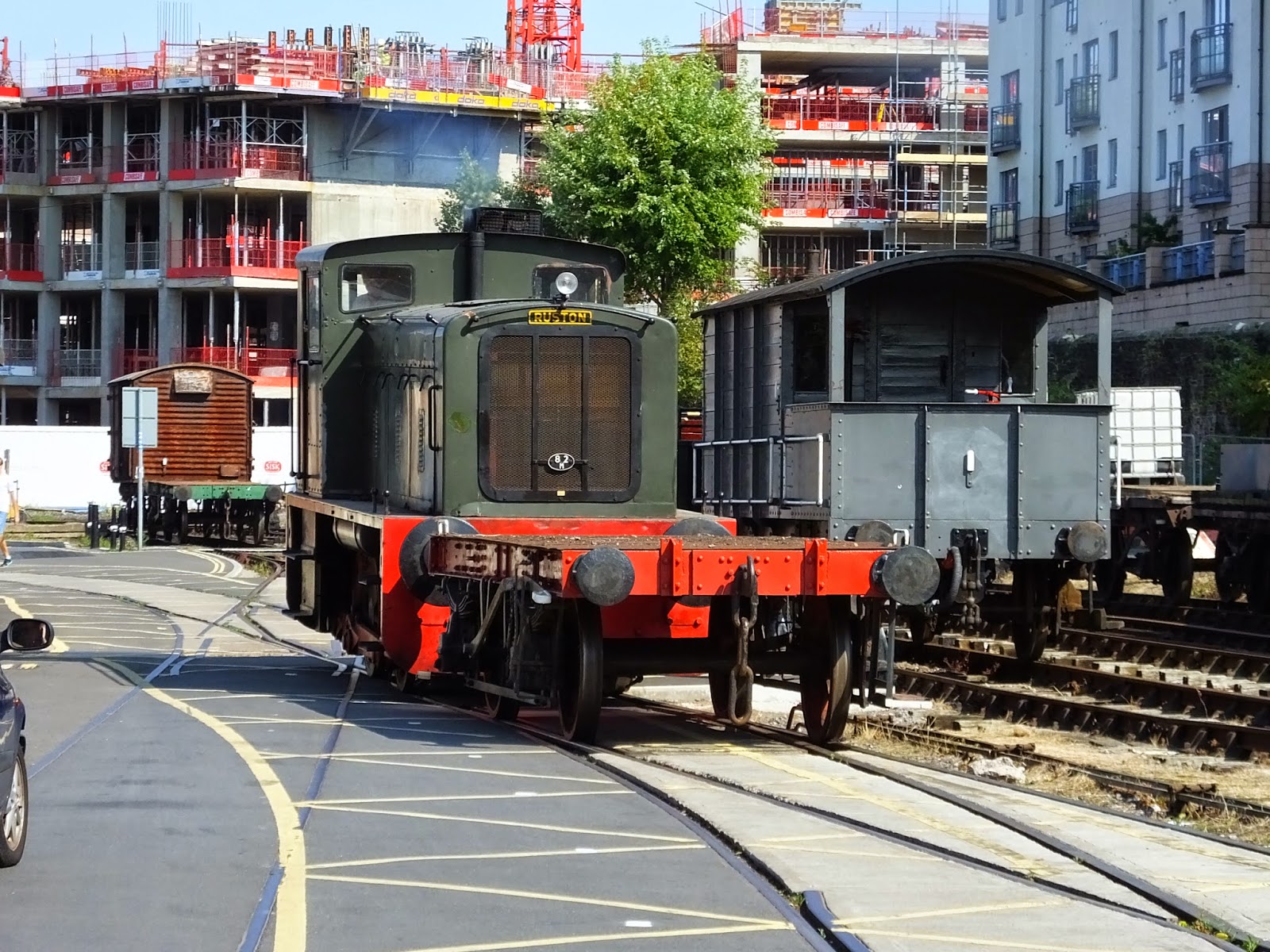
The Ruston (called The Bug on the railway).


Double slip.


Retro.


Portbury on shed, repositioned for work!


Tracks and cranes.

(All pics copyright Steve Sainsbury/Rail Thing 6.8.2014)


It was my birthday today (again). Normally we go on a rail trip but the weather forecast for today was so awful we went to see the first showing of the new Inbetweeners film instead, followed by a trip into Bristol for a meal and many cocktails at Las Iguanas. The weather was actually fantastic, the forecast rain coming through overnight rather than in the morning and as we came out of the restaurant we decided to go for a walk along the harbourside.

Soon I thought I heard a diesel horn but put it down to the cocktails. Then across the water we saw activity on Bristol's secret heritage line, and it was indeed a diesel shunter. The two steam locos, Henbury and Portbury, were out too. I'd never seen the harbour line operating other than on occasional weekends. Problem was it was the other side of the water. Luckily, being an honorary Bristolian now, I knew there was a ferry up by the SS Great Britain that would get us across. Amazingly there was a ferry waiting and we quickly made the short trip across the water. We followed the railway along the street section and I just caught the Ruston diesel pass and then vanish up towards the Create Centre.

We chatted to a couple of the blokes working on the line to get the story. Henbury was just out of ticket and they'd been cleaning her boiler out. Same with Portbury who will now be pulling the trains for a while. The locos also needed repositioning so that Portbury would be at the front of the loco shed, with Henbury behind. Luckily we also got to see the two steam locos in the shed and I got to take a few photos.

The Bristol Harbour Railway is a real gem, but seems little known outside of Bristol. It links three major tourist attractions (one of national importance) - the SS Great Britain, The M Shed (free Museum of Bristol) and the fantastic Create Centre, which looks at sustainability, climate change, peak oil etc, all the stuff that's so important now. It's not a long line but it has a lot of variety including a fair stretch of street running, a harbouside stretch, a 'country' stretch, a run along a river and some urban bits as well. Highly recommended! Passengers also get to sit in open wagons ...

For those of you interested in disused lines there are plenty of them on both sides of the harbour and at each end of the Harbour Railway. The current terminus of the railway at Create is only about 300 metres from the (soon to be reopened to passengers) line to Portishead. You won't be stuck for things to do and see if you visit!

More info


The Bristol Harbour Railway is a preserved railway in Bristol, England operated by Bristol Museums Galleries & Archives. It runs for about a mile along the south side of Bristol Harbour, starting at M Shed (the former Bristol Industrial Museum(51.4483°N 2.5969°W)), stopping at the SS Great Britain, and ending at B Bond Warehouse (home of the Create Centre), one of the large tobacco warehouses beside Cumberland Basin (51.4466°N 2.6213°W).

The original Bristol Harbour Railway was a joint venture by the GWR and sister company the Bristol and Exeter Railway, opened in 1872 between Temple Meads and the Floating Harbour. Its route included a tunnel under St Mary Redcliffe church and a steam-powered bascule bridge over the entrance locks at Bathurst Basin. In 1876 the railway was extended by 12 mile (0.80 km) to Wapping Wharf.
By Act of Parliament of 1897, the GWR was authorised to make an eastwards connection between the BHR and the Portishead Railway, and then create the West Loop at Ashton Gate which would face south towards Tauntonand Exeter Central. This connection would allow a doubling of BHR rail access capacity to the Great Western main line. In 1906 this authorised extension was constructed, with new branches from the south via the Ashton Swing Bridge were built to: Canons Marsh on the north side of the Floating Harbour; and to Wapping via a line alongside the New Cut.
The Temple Meads connection was closed and the track lifted in 1964 (the bascule bridge engine survives in Bristol Museums). The Canons Marsh branch closed the following year, with the Canons Marsh goods shed is now the home of Explore At-Bristol, a hands-on science centre. The Western Fuel Company continued to use the branch from the Portishead line and Wapping marshalling yard for commercial coal traffic until 1987.
In 1978, the preserved railway was established as an element of Bristol Industrial Museum using locomotives built in Bristol and formerly used at Avonmouth Docks. At first, it connected the museum with the SS Great Britain, but when commercial rail traffic ceased in 1987 the museum railway expanded to use the branch alongside the New Cut. When the Portishead Railway was relaid the connection at Ashton Junction was severed.
Today the railway operates on selected weekends on standard gauge track over 1.5 miles (2.4 km). The railway is currently in use as far as B Bond Warehouse (home to the Create Centre and Bristol Record Office), a mile from the museum. On the south side of the harbour the railway crosses Spike Island, the narrow strip of land between the harbour and the River Avon, and clings to the side of the river as far as the junction with the northern branch at the Cumberland Basin. The former route east over the Swing Bridge is now the Pill Pathway rail trail andcycleway.
In 2006, Bristol Industrial Museum was closed and the site redeveloped into M Shed Museum of Bristol. The railway continues to operate between SS Great Britain Halt and the Create Centre, and in 2011 the railway became part of M Shed's working exhibits.


Thursday, 24 July 2014

HS2 - the ultimate anachronism


HS2 is a VERY divisive issue. It is planned to churn up and destroy huge swathes of priceless English countryside, it will cost billions - and for what?

Now as a rail activist you'd probably expect me to fully support HS2. But I don't. In fact I consider it to be a HUGE misallocation of resources, right up there with fracking, motorways and tourist trips to space. It's being pushed as some sort of panacea for the economic 'problems' that face us - but in reality it's part of the problem. It's being presented as a replacement - as a competitive product - for internal air travel, but air travel is doomed anyway, there is no substitute for kerosene which is used to power planes. It's being presented as competition for the road network, but roads are in their final few decades anyway.

And what is it designed to do? Well there's the genuine reason of increasing rail capacity, something EVERYBODY supports - but that can be addressed through the reopening of the Great Central railway and improvements to the existing West Coast Main Line route. Most of the Great Central is still there and can be rebuilt with minimum disruption - it certainly won't cut through virgin countryside!

But the real issue with HS2 is that it is no longer needed, not as a high speed route. We are entering an era of reduced energy availability and economic chaos. The last few years have been a picnic compared to what's coming. The upshot of all this is that within a few years the ONLY criteria for transport development will be ENERGY EFFICIENCY coupled with RESOURCE USE AND AVAILABILITY. Sadly HS2 is a line planned for the past, not the future. None of us will be wanting to get from London to Birmingham in 20 minutes less than it currently takes - we'll be at home growing our own food and trying to earn a small income turning our hands to making things. The old corporate system will have collapsed long before the first HST runs, the market will no longer be there. This is a white elephant even in its current (and probably permanent) stage. People are realising, but of course in the process they are also having the face the reality of an energy constrained future and all that means for standards of living and mobility etc. For THEM. And that's not an easy process.

What IS needed is a massive rebuilding of our currently sleeping rail network. The closed branches and cross-country routes that were destroyed quite deliberately in the 60s by philistines. We need a full passenger and freight service for the REAL future. ALL towns and villages, farms and factories, markets and communities will need some sort of rail access for the future, be that a main line, branch, light railway, tramway or ultra-light rail. In reality the polar opposite of the vanity project that is HS2, an anachronism of the highest order.

The cover shot is of the Dublin and Blessington Tramway which closed in the 30s. Even then it was described as an anachronism. But, if things turn out as expected, the roadside tramway run by steam or electricity IS the transport future, in a world without roads ... and without high speed trains. That is what we should be working towards, embracing the future rather than trying to grimly hang on to a past that is already fading into history ...

Sunday, 29 June 2014

Church Stretton 1986


(All copyright Steve Sainsbury/The Rail Thing 8.5.1986)

FACEBOOK - CLASSIC GREAT WESTERN/WESTERN REGION

My only visit to Church Stretton was on 8 May 1986. It was a surprisingly busy station on this scenic line with a fair amount of variety including a class 33 on a passenger working. This line is even busier today of course. The station is also carefully maintained by volunteers and is a real asset to the town.


Church Stretton railway station serves the town of Church Stretton in Shropshire, England. The station is situated on the Welsh Marches Line, 12 34 miles (20.5 km) south of Shrewsbury railway station, while trains on the Heart of Wales Line also serve the station. All trains serving the station are operated by Arriva Trains Wales, who also manage the station.
The station lies on the highest point of the line between Shrewsbury and Craven Arms, and is the highest station in Shropshire. There is on the northbound platform a small plinth noting the station's altitude: 613 ft (187 m) above sea level.

History


The site of the original (1852) station, north of Sandford Avenue

The station opened on 20 April 1852 as part of the newly created Shrewsbury and Hereford Railway along with the rest of the line and stations. It was originally situated to the north of (what is now known as) Sandford Avenue and the old station building still remains, but is no longer in railway use. Sandford Avenue had been for centuries called Lake Lane and became Station Road with the arrival of the railway in the town, before becoming Sandford Avenue in 1884. The original station building was designed by Thomas Mainwaring Penson.

In 1914 the station was relocated just to the south of the Sandford Avenue road bridge, where it continues to the present day. New station buildings were erected, but these were demolished in 1970, the station having become unstaffed in 1967. Today the only station structures in use are two passenger shelters on the platforms and a footbridge.

Today's station


The southbound passenger shelter on platform 2 (since replaced)

The station has two platforms, one for northbound services (platform 1) and the other for southbound services (platform 2), with a footbridge crossing the line connecting the two platforms. The platform shelters were replaced and electronic information displays were installed in the spring of 2011. CCTV was also installed at the time and together with the new shelters has resulted in anti-social behaviour becoming almost non-existent at the station. In 2013 a ticket machine was installed at the station, on platform 1.

There are two small areas for car parking/dropping off, on either side of the line – one can be accessed from Sandford Avenue (the B4371), the other from Crossways (which comes off the A49).

Volunteering


The plinth on platform 1

The station has been "adopted" by local volunteers and is regularly kept tidy by them, including the garden areas behind both platforms. In 2008 a group of volunteers undertook to transform the unattended station gardens and two years later were awarded the Station Gardens of the Year competition. In 2011 a tree sculpture depicting two owls was carved by David Bytheway. There is also the Church Stretton Rail Users' Association.

Services


King Edward I steam charter train at Church Stretton, passing a regular DMU service.

For a town of its size, Church Stretton is comparatively well served by trains, although services are less frequent on Sundays. A number of passenger services operating on the Welsh Marches Line do not stop at Church Stretton, particularly on weekdays (Monday to Friday).

On weekdays, northbound trains run to Shrewsbury, and most continue to ultimate destinations such as Manchester Piccadilly, Holyhead etc. Southbound trains mostly run to Cardiff Central or beyond via the Welsh Marches Line, but four run to Swansea via the Heart of Wales Line.

Passenger use

The station has a large number of passengers using it considering the town has a population of just 3000; it is the 7th most-used station in Shropshire (the fifth for the Shropshire Council area). The high usage can be explained by two reasons: the town is a popular tourist destination and many of its inhabitants travel to Shrewsbury and Ludlow for employment, education and shopping.

Infrastructure


Looking south, showing the now removed signal box, signal and crossover, as well as the three (extant) bridges crossing the railway in the town.

The track through the station is prone to flooding when heavy rain occurs as, although at the apex of the line, it is at the bottom of the valley which Church Stretton is found in. (Church Stretton effectively lies at a saddle point.) At one stage during the infamously wet autumn of 2000, the space between the two platforms resembled a canal and train services had to be cancelled along the line.

Following the serious flooding of the railway line in 2000, the signal box at Church Stretton (which was situated to the north of the Sandford Avenue bridge) was "switched out". The signal box at Church Stretton closed entirely in 2004 and the set of points at the station lay defunct for a number of years and were removed in 2009, together with the box (built 1872) and all signals. The control of the line here has been transferred to Marsh Brook signal box, which is to the south.

Saturday, 28 June 2014

Deepest Surrey 1986


HOLMWOOD


(All copyright Steve Sainsbury/Rail Thing Holmwood 30.4.1986)


An odd little line in Surrey is the line from Horsham to Dorking. Back in 1986 it was something of a backwater, except during the rush hours. The line was busier from Dorking northwards, the line south via Warnham, Ockley and Holmwood served a very rural area, with the non-peak trains running empty or almost empty. I haven't visited the line since 1986 so no idea what the situation is like today!


The station opened in 1867 in what was the far north of the parish of Capel along the London, Brighton, and South Coast Railway line to Portsmouth. Why it was called Holmwood is mysterious, however Beare Green was a smaller settlement than the Holmwood area which was expanding with building at the time.

Holmwood for many years had until a revised timetable of 10 July 1967 two hourly services during the day in each direction:
  • to and from Waterloo and Horsham
  • to and from London Bridge (via Sutton and Tulse Hill) and Horsham.
In respect of the first route where on time the journey was completed in less than 55 minutes: no slack, allowing for lengthy boarding assuming identical track speed, was built into the timetables. Of relevance to Bognor Regis, a once an hour non-stop express Victoria service went through the station from the coastal resort.
Further, Holmwood was a terminus for various additional trains to and from Waterloo.


The Grade II listed signal box

Prior to 1963 the use of Holmwood as a terminus was implemented for much of the day. For example, a serious accident at Motspur Park on 6 Nov 1947 involved the 16:45 Southern Railway train from Holmwood to Waterloo. This service was withdrawn in 1963, the later 17:45 being the last of a series of hourly trains from Holmwood to Waterloo to be retained in the 1963 timetable. The accident in 1947 resulted from incorrect manual fog signalling when the driver of the Holmwood train was given permission to enter the junction at Motspur Park before the down Chessington train had cleared the junction, and before the signals and points were changed by the signal box. This is one of the few references one can find to the important role that Holmwood station played in the Sutton and Mole Valley Lines to Waterloo service initiated in the early 20th century by the Southern Railway. Before nationalisation in the 1940s, the Southern Railway built, owned its trains, running from today's two London termini as well as Waterloo following the formation of the Big Four.

Thus the earlier timetables for services on the line from London Victoria to Horsham in 1905 and 1917 show that services to London Waterloo and London Bridge adhering to the Victorian service pattern from Holmwood, Ockley and Warnham being to London Victoria only.

Some features of the unusual service pattern endure include its last evening weekday rush hour service from London Victoria at 7:20pm (apart from the 11:26pm weekday service added to the timetable in December 2004 following several years of pressure from a local campaigner) traceable to the Victorian/Edwardian origins.

From at least Victorian times (or quite probably from the opening of the line in 1867) until the middle of the 20th century the line also had four services to and from London Victoria in each direction on a Sunday compared to no Sunday service at all in current times. There were two services in each direction in the early morning and two more in the late afternoon/early evening (a total of eight trains in all on the Dorking to Horsham section of line during the day) making Sunday outings to the Capital and elsewhere possible in this still largely pre-motor car era. However it is not clear from easily available records precisely when Holmwood and the neighbouring two stations of Ockley and Warnham lost their Sunday railway services.