Sunday, 13 April 2014

swiss tragedy


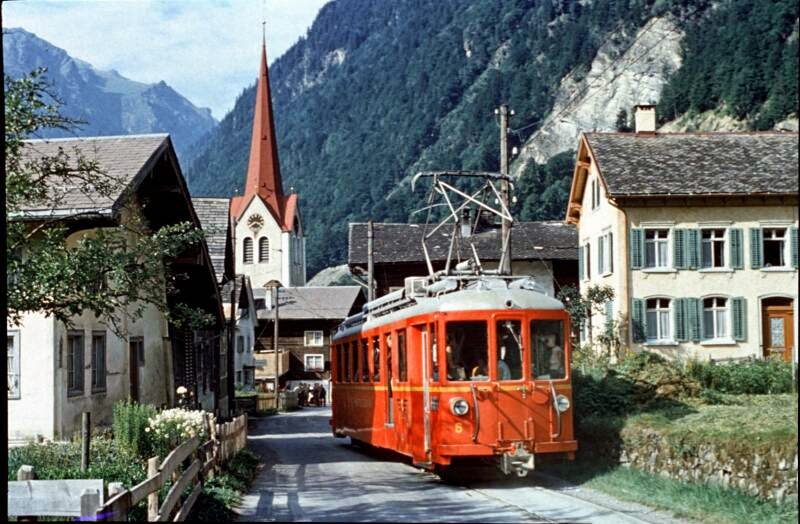
Switzerland is generally regarded as being one of the most forward thinking countries in terms of transport, with a superb rail system reaching almost everywhere in the country. It's efficient and clean and does a superb job.

So how on earth did the Swiss ever allow a railway to close?

That's exactly what happened to the charming Sernftalbahn which ran from Schwanden to Elm in Canton Glarus in 1969.

It didn't close because it was losing money but simply because the military wanted to improve the road between the two towns. As the railway used the road for most of its right of way it had to go.

So Switzerland lost one of its most interesting railways and the towns and villages along the way were suddenly deprived of modern transport, not a great idea as the snowfalls in this area can be huge.

The line ran alongside country roads and through the heart of villages en route. It offered an excellent passenger and freight service the year round, and would surely be a huge tourist attraction if it still ran. There is a preservation/museum group and the line may of course return one day, but at the moment all is quiet along the valley.

A few other lines have closed in Switzerland, the Leuk-Leukerbadbahn was one. A few in Ticino also closed, the cantonal government there not being as forward-thinking as elsewhere in Switzerland. A few other short lines around Lake Geneva have also vanished, but generally most Swiss narrow gauge light railways are busier than ever and it would be hard to imagine many places without them.


Monday, 7 April 2014

a salutary lesson


Hopefully you're puzzled, or at least intrigued, by the title of this post! We'll get there, but first some background ...

My brain is full of little images and memories, like most peoples I suppose. This is a specific one. I remember seeing, in the early sixties, a newspaper article about a group of plucky volunteers restoring a branch line down in Kent. They were almost there having already raised the money, which seemed like a huge sum of money to me but would be chickenfeed today. The article was accompanied by a very emotive picture.

Then I moved on (school, holidays etc) and lost interest in railways ... until rediscovering them in the late 60s.

I discovered closed lines and holiday lines and preserved lines. The Bluebell, Dart Valley etc. I got that little annual book that listed heritage lines and started reading through.

But try as I might I could not find the Westerham Valley Railway. It finally sank in that all that promise, all that hope, had obviously come to nothing.

The full story of what happens follows at the end of this piece, so I won't go over it here in detail. But the scheme did fall through, seemingly due to council shenanigans and other strange 1960s style stuff. The vile M25 was involved and probably a few backhanders. This was back in those grey road lobby days, which to us  now is a different country.

So the promising pioneer heritage line didn't happen. And neither did millions of pounds of economic activity. Neither did friendships that never happened because the line wasn't there to bring people together. Businesses that would have formed and thrived never happened. And house prices have probably been a few points below what they would have been if there had been a commuter rail service to Westerham, Brasted and Chevening.

What a loss. The Westerham Valley Railway was the PERFECT heritage line. A main line connection, three stations, an intact infrastructure, the ideal length (between 4 and 5 miles), huge catchment area. And the potential for a real community service to keep commuters connected.

So the real salutary lesson is to all those people that never got their train, all those businesses that never got their customers. And the lesser lesson is to us, to never really rest on our laurels and never step off the accelerator until the cat is in the bag.


The two pics that accompanied that original 1960s article!

Classic shot of the route.


My favourite shot of the line.


Further information - (via Wikipedia)

Westerham Valley Railway Association

Flyer distributed by the Westerham Valley Railway Association in c1963

In 1962, the Westerham Valley Railway Association, born of a merger between two local interest groups, the Westerham Branch Railway Passengers' Association and the Westerham Valley Railway Society, began to investigate the possibility of re-opening the line, staffed by volunteers, for commuters on weekdays and as a heritage railway at weekends between April and October. British Railways offered the ownership of the line for £30,000 on the basis that a commuter service would be provided, thereby allowing it to cease its subsidies of bus services which were now over-subscribed following the closure of the Westerham branch. In July 1962, British Railways granted a lease of Westerham Station building, which became the Headquarters of the Association. A lease of Brasted Station was also later agreed.

Offer to purchase the line

However, British Railways were later to change their policy regarding the disposal of disused branch lines and, as they had done with the Bluebell Railway, were no longer prepared to simply lease the line to a private operator. Instead, they now required an outright sale of the line to the Association for £53,000. Thanks to the help of an anonymous backer, the Association was able to put forward an offer of £30,000 for the track, buildings, land and branch platform at Dunton Green. British Railways accepted this offer subject to the condition that a commuter service be provided, thereby enabling it to cease its annual subsidy of £8,700 towards the additional bus services laid on following the line's closure.

Intervention of the Kent County Council

The withdrawal of the backer following the refusal of his planning application to develop land at Westerham Station cast serious doubt on the proposed re-opening. In the Association's Annual General Meeting on 2 November 1963, members were informed that efforts to raise the £30,000 plus £10,000 for equipment had failed. Furthermore, British Railways were now in talks with the Kent County Council regarding the sale of the line to enable the construction of the proposed "Orbital Motorway", what would later become the M25 motorway.
The A21 near Chevening crossing the route of the line running left to right

More positive news was received later in November 1963 when it was revealed that not only had a new backer been found, but also that terms were agreed with British Railways for the sale of the land to the Association. However, one month later, Kent County Council contacted the Association and informed them that the Council's intended purchase of the land would save taxpayers the sum of £120,000 and, furthermore, that in the event British Railways were unwilling to sell the land to it, as had been intimated, compulsory purchase powers would be used. Faced with the prospect of a compulsory sale, British Railways now broke off negotiations with the Association and agreed to sell the line to the Council.

Westerham Valley Railway Association platform ticket
However, in April 1964, the Council indicated their willingness to lease the line to the Association, thereby ensuring the line's continued existence if the Association were to come up with the cost of constructing a bridge over the railway cutting at Chevening to enable the Sevenoaks bypass to cross it. The cost of this bridge was estimated by the Council at £14,000, added to which was the annual rent of the line of £3,000. The estimate of £14,000 was revised upwards in August 1964, to a figure of £26,215 (equivalent to £355,800 in modern currency) which was to be paid by 24 August, otherwise works would commence to infill the cutting.

Purchase of rolling stock

In the meantime, the purchase of several former Metropolitan Railway coaches and a Class H 0-4-4T locomotive No. 31263 had been agreed and were awaiting collection. Initially, British Railways had allowed the stock to be stored at Dunton Green, but since the intervention of the Kent County Council, it became 'reluctant' to allow this and threatened to scrap the stock were it not collected. The coaches were loaned and later sold to the Keighley and Worth Valley Railway and the locomotive to the Bluebell Railway where it remains today.

Final days

By November 1964 the funds to construct the bridge had still not been found and, following the infilling of the Chevening cutting, the Association realised that their plans to re-open the line could no longer be realised. This was notwithstanding intervention by the MP for Faversham, Terence Boston, who unsuccessfully attempted to persuade the new Labour Minister of Transport, Tom Fraser, to hold an enquiry into the County Council's plans to convert the line into motorway.
In autumn 1965, the Association merged with the Kent & East Sussex Railway Preservation Society. By March 1967 the railway track had been lifted and Westerham Station demolished. Works on the section of the M25 from Sundridge Road to Westerham commenced in December 1976 and were completed in December 1979.
Tuesday, 1 April 2014

longmoor military railway


Liss LMR 6.7.1977 (Copyright Steve Sainsbury/Rail Thing)

Back in 1970 and still a bit wet behind the ears I took a little excursion out to see what remained of the Longmoor Military Railway, closed just a year earlier. I was staying in Winchester so accessed it via Alresford and Alton (on the Watercress Line) then to Bentley, where I'd hoped to catch a bus. Unfortunately it was a bank holiday - no buses - so I had to walk! I did finally find the Bordon end of the line, track was still down but all I have is a few vague memories, as it wasn't until a year later that I started taking photographs.

Just a year earlier I could have travelled on the line on its last Open Day, behind steam, but life for  a rail fan in the 60s and 70s was often a case of near misses!

A few years later I did get to stop at Liss and see the revival project's stock of steam locos and rolling stock, but yet again no camera! The preservation scheme was scuppered by peculiar locals who were convinced that a heritage steam line on their doorsteps would LOWER the value of their properties - idiots!

The LMR was an unusual railway, fairly recently built, it had a circular run, ungated level crossings, open days and heavy passenger and freight services. It was also immaculately maintained. It starred in a few films, probably the best was the Great St Trinian's Train Robbery, where it was really the star. 


----------------------


More info (via Wikipedia) - Authorised for construction from 1902, activities date from 1903 when an 18 in (457 mm) gauge tramway was laid to assist in removing 68 large corrugated iron huts from Longmoor Military Camp Camp to Bordon.

The railway was relaid to 4 ft 8 12 in (1,435 mm) standard gauge in 1905–1907 and was initially known as the Woolmer Instructional Military Railway. It was renamed the Longmoor Military Railway in 1935. The Liss extension was opened in 1933. The stations and junctions included:
An additional loop ran eastwards from Longmoor camp via a station at Hopkins Bridge to Whitehill Junction, completed in 1942. This provided circular running to the line, allowing for improved training without the need to turn trains at the terminals.

As a training railway, it was often being constructed/deconstructed. The layout would often change, and at one time housed a machine which could lay 1,500 yards (1,400 m) of track a day. At its peak, the railway ran to over 70 miles (110 km) of operational laid track and sidings.

Operations

 
The trackbed of the Military Railway in 2007, looking north from near Woolmer
 
The trackbed looking the other way, with Longmoor Camp around the curve to the left

The vehicles and stock on the LMR were very much an assortment to give the maximum learning opportunity. Well over a thousand locomotives had associations with the railway, although many only through the need for storage. The same was true of the signalling at the various locations on the line, including an Army version of flag signalling. After the end of World War II, the collection also included captured enemy equipment, including a "Schienenwolf" or railroad plough: a German wagon which dragged behind it a huge hook, used to destroy sleepers and so render railway lines unusable to advancing enemy troops.

In addition to the various military items, there were old versions of standard passenger carriages. A passenger service was operated over the line at various times, nominally for personnel required on the railway, and others from the War Department/Ministry of Defence and their families.

There was only one fatal accident recorded on the line, which occurred in October 1956. With a declining military role for railways both in Britain and the rest of the world, it was inevitable that the significance of the facilities offered by the LMR would be reduced in later years. Even so, the LMR was still important enough for the tracks of the Bentley to Bordon branch to be left in place when passenger services were withdrawn on 16 September 1957. This line remained in place as, although there was a British Railways connection at Liss, the Bordon branch made it easier to accommodate the movements of military traffic at short notice. In 1966, the movement of goods over the Bordon branch was suspended, and the line was taken up in 1967.

In light of the reducing role of the military and the severely reduced British Empire, it was decided by the Ministry of Defence to close the railway. On hearing of its impending closure local locomotive preservation groups became interested in acquiring the small but complete rail system, and a bid was placed to purchase LMR along with the airstrip at Gypsy Hollow which would have enabled the production of a unique transport museum. The MOD rejected this proposal, which had been backed by the Association of Railway Preservation Societies and The Transport Trust. However the Army did offer the last 1½ miles of line from Liss Forest Road to Liss. The offer was accepted, a provisional lease was drawn up and planning permission was sought for developments at Liss.

Unfortunately the people of Liss did not share this enthusiasm and opposed the planning permission. Several residents raised £9,100 in a successful bid to buy this last piece of line. Longmoor Military Railway closed down with a ceremonial last day of operation on 31 October 1969, though for another two years some locomotives and stock remained on site, and there were occasional movements. Three items of rolling stock (a van, a brake van, and a bogie flat) still remain on the Longmoor site, as part of the FIBUA training village.


Monday, 31 March 2014

round and about lisbon


All pics copyright Steve Sainsbury/Rail Thing.


I've just returned from my first ever visit to Portugal. We were staying in the heart of Lisbon and had 5 days of travel cards, so made plenty of use of the trams and trains.

Portugal is a very pleasant country, both laid back and efficient. The same applies to the transport! Some of the tramway routes are out of this world (and will be described in future posts). The trains are very regular. Everything is busy, even overcrowded. 

There are also the elevators, there are three tram-style ones and a straightforward (but very Gothic) lift. One of the elevators was less than a minute from our hotel door. There were also closed tramways and a very efficient Metro.

All in all a great week with some unique experiences (including my first tram crash!) and will provide lots of future material for this blog.


Monday, 17 March 2014

subtle changes to hs2 ...


Interesting. The old HS2 is being buried bit by bit. They are even saying that they wish the 'HS' part had never been promoted. Perhaps politicians are, at last, realising that this is the 21st century, not the 20th?

Because, it seems to me, that spin is being rolled out to transform the old vanity 'space paste' project into something far more interesting. New lines and links are being planned, the capacity issue is being promoted over and above the laughable speed one and we're beginning to talk about a railway line rather than something out of Flash Gordon ...

And who knows what further tweaks will be given to the look of this as it heads towards either building or abandonment? It seems that reality is beginning to creep in, that the idea of building a line that people will need and use and, most importantly, will serve a role in the very different economy that's coming, is what's being served up. It appears that the line formerly known as HS2 is transforming into another everyday line that will solve many problems on the existing network, possibly the first route designed to replace the motorway network, which we all know is doomed.
Perhaps with stations and freight handling facilities?

So from being totally disinterested in something that was, to me, a silly dream by nostalgists and politicians stuck in the first half of the twentieth century, perhaps now my ears will prick up a little when it's mentioned. Who knows, I may even blog about it?


Sunday, 16 March 2014

The other Kent and East Sussex


Eridge 2.1.1973


1317 at Groombridge 4.7.1977


Tunbridge Wells West 31.8.1988 

(All pics copyright Steve Sainsbury/The Rail Thing)


By the mid 1980s railway closures were a fading memory, but in a last burst of misplaced nostalgia there was one final closure down south, when the useful (but not as useful as it will be!) route from Tunbridge Wells to Eridge was closed. The excuse was the expense of remodelling the junction at Tunbridge Wells when the main Hastings line was electrified ... and so another part of the network of lines in this area had to close.

The line was quickly resurrected as the Spa Valley Railway, but a few tourist trains hardly compensates for the loss of a seven day a week service. And that important link at Tunbridge Wells is STILL devoid of track.

I got to travel on this line a few times and it was a nice rural route. I must admit that by the 70s a lot of the line's purpose had gone. Once it had provided a gateway to lines to Brighton, Lewes, Eastbourne, East Grinstead and Three Bridges, offering a huge range of trips and keeping a good bit of traffic off the roads. It also made commuting an easy proposition in a whole swathe of this region. By 1985 it really just provided a link between Tunbridge Wells and Uckfield (Lewes no longer being an option) and also allowed people in the West of Tunbridge Wells to access the Network (and London) via the large and gothic station at Tunbridge Wells West.

So the line was closed, the last real closure of any substance in southern England and possibly the whole country. A final fling for Beeching and his empty headed accountant hordes.

But things are stirring. As mentioned above a good stretch of the line is now a tourist railway, but the Lewes-Uckfield line is on the cusp of reopening, there are murmurs about the useful 'Cuckoo' line to Eastbourne and the East Grinstead line now has a group working with banks and others in the area to reopen this useful link (at least for a few more decades) to Gatwick Airport and, more importantly, the Brighton main line. East Grinstead of course has had it's other line (to Sheffield Park) reopened last year, and the Bluebell have a 25 year and beyond plan that mentions a possible return to Lewes. The whole area will be transformed for rail.


Withyham 4.7.1977

Still in deep sleep the useful route from Eridge via East Grinstead to Three Bridges is beginning to stir again.