Wednesday, 9 March 2011

rural dorset 1973


(All © Steve Sainsbury/Rail Thing 7.8.1973)


 Four shots taken at Maiden Newton back in 1973. I'd visited here to travel on the Bridport branch (which will no doubt feature in future posts!) but the junction station itself was still a gem back then (and may well still be!)

The 'main' line is if course the Dorchester to Castle Cary route which had suffered some 'rationalisation' in the 60s, losing a lot of the intermediate stations and being single tracked. The line now is very busy and it can't be too long before double track is reinstated and hopefully some of the closed stations reopened. Whether the Bridport branch is reinstated is another matter. It is more likely that a wholly new route from Bridport will eventually be built to a junction somewhere on the (now buzzing!) Exeter to Salisbury main line, another route that suffered rationalisation in the 60s, much to everyone's regret now!

But back in 1973 railways were on the back foot, you could often be the only passenger on a train and much of the old steam-era infrastructure remained. The diesel units in these shots are also now ancient history, as are my brother's flares in picture 3!


Maiden Newton railway station is a railway station serving the village of Maiden Newton in Dorset, England. The station is located on the Heart of Wessex line between Castle Cary and Weymouth.

History  

The old signal box
Opened on 20 January 1857 by the Wilts, Somerset and Weymouth Railway with the section of their route from Yeovil Pen Mill to Weymouth. This completed their main line from Chippenham to Weymouth, the first part of which had opened in 1848. The railway was a part of the larger Great Western Railway which meant that through trains ran from London Paddington station.
The station consisted of two platforms with a flint station building and goods shed at the south end. A signal box was added later.
From 1857 to 1975 the station was the junction for the Bridport Railway and an extra bay platform was added at the north end of the station for these trains. This can still be seen at the west end of the station and this end of the trackbed is a footpath and cycleway.
Preceding stationHistorical railwaysFollowing station
Cattistock Wilts, Somerset and Weymouth Railway Grimstone and Frampton
Terminus Bridport Railway Toller

Description 

Looking north
Although the signal box was closed during a rationalisation scheme, the station retains two platforms as it is a passing place on the single line between Dorchester and Yeovil. The entrance is on the northbound platform, the side closest to the village. Access to the southbound platform is normally by the footbridge but there is a level crossing at the south end of the station for passengers who are unable to use the bridge. The station building survives but is no longer used by the railway.
The electric key token instrument for the block section to Yeovil are now operated by the train crew under the supervision of the signal operator based at Yeovil Pen Mill. The block section to Dorchester West is operated under the 'tokenless single line' principle with track circuiting.

Services

The station is served by Great Western Railway. Services originate from Gloucester and Bristol Temple Meads (apart from one early morning service from Westbury) and are operated by Class 150Class 153 or Class 158 diesel multiple units. Eight trains in each direction call Mondays to Saturdays and three each way on Sundays all year (plus two additional trains in the summer months).
Preceding stationNational Rail National RailFollowing station
Chetnole Great Western Railway
Heart of Wessex Line
 Dorchester West
Annual rail passenger usage*
2002/03  22,133
2004/05Decrease 17,635
2005/06Increase 18,252
2006/07Decrease 16,462
2007/08Increase 17,600
2008/09Increase 22,070
2009/10Increase 22,680
2010/11Increase 23,058
2011/12Decrease 19,652
2012/13Increase 21,242
2013/14Decrease 20,258

Saturday, 26 February 2011

the smallest gauge in Switzerland


(All 25.5.1987)

Most of Switzerland's minor lines are metre gauge but the Waldenburgerbahn is just 750mm gauge. This line is really a roadside tramway running from Liestal to Waldenburg. Despite its small gauge the trains are pretty spacious and the line is very busy.

There are plans to eventually convert the line to metre gauge and to this end any future infrastructure works will be large enough to accomodate this. there's also talk of eventually connecting the route to the Basel tramway network at Pratteln, though this is obviously dependent on the gauge change!

With these changes being put forward it would be a good idea to visit the line when you can as the 750mm gauge line may not be there for ever.
Posted by Picasa

Saturday, 12 February 2011

salisbury 1983


(All 27.10.1983)

Salisbury was always a favourite photographic location for me. In the 80s, like today, it was exclusively diesel operated, but still had very much a steam and 60s atmosphere. Of course back then I regretted missing the steam period, but then I reckon we all feel we were born a few decades too late!

The point is - get down there and photograph everything that goes through NOW - it's even easier with digital photograpy. Nothing stays around long on the railways, or stays the same. One thing is for certain - in thirty years time there'll be no diesels at Salisbury. All trains will be electric or steam!
Posted by Picasa

Monday, 3 January 2011

weymouth's 'tramway'


(All 3.5.1975  copyright Steve Sainsbury/Rail Thing)


Weymouth's 'tramway' isn't really a tramway at all, but a long street-running branch linking the main line (not Weymouth station) with Weymouth Harbour station. At the moment it is mothballed, but far too valuable an asset not to be revived when the time is right. The rails are still in the road, although they haven't seen a train in many years. The plan is to restore the route and extend it along the prom - a total no-brainer which should become a major - and unique in the UK - attraction.

This was a special run in 1975. I travelled the line a couple of other times, always on specials. I tried to use a timetabled service in about 1973 but was caught and thrown off by the guard after being told my rover ticket wasn't valid!
Posted by Picasa

Tuesday, 28 December 2010

diesels under the wires


(Photos Leyland, 24.5.1985 copyright Steve Sainsbury/Rail Thing)


I'm firmly convinced that diesels will have all but vanished from our railways by 2040. This is because of Peak Oil, which will make the running of these machines totally uneconomic, and is now official government policy. We'll see all railways either electrified or run by a new breed of steam locomotives, using super efficient wood burning as power.

The above four pictures all show diesels running under the wires at Leyland on the West Coast Main Line back in May 1985.

I'd encourage all railway enthusiasts to photograph this transitional form of transport whilst they still can! Once they are gone they really will be gone for good.

Monday, 27 December 2010

uckfield


UCKFIELD


(All 4.7.1977 copyright Steve Sainsbury/Rail Thing)


This was Uckfield back in 1977. The station has now been resited to the north of the level crossing and this scene has vanished.

The line used to continue to Lewes, double track throughout and a very useful diversionary route when the main London-Brighton route was blocked. The dinosaurs still saw fit to close this route in 1969 but the call for reinstatement has never gone away and is now stronger than ever.

It's inevitable that this line will be reopened in the not too distant future, and hopefully electrified, once again allowing it to take some of the pressure off the main London to Brighton line. So trains will doubtlessly pass this point again!

LINKS

Rail Thing Routes - Rails of Sussex
Southern Region Scene - 1970s
Rail Thing - British Railway Stations and Buildings
Rail Thing - Vanished Rail Scenes

Sunday, 19 December 2010

monorail


(All 23.11.2010, copyright Steve Sainsbury/Rail Thing)


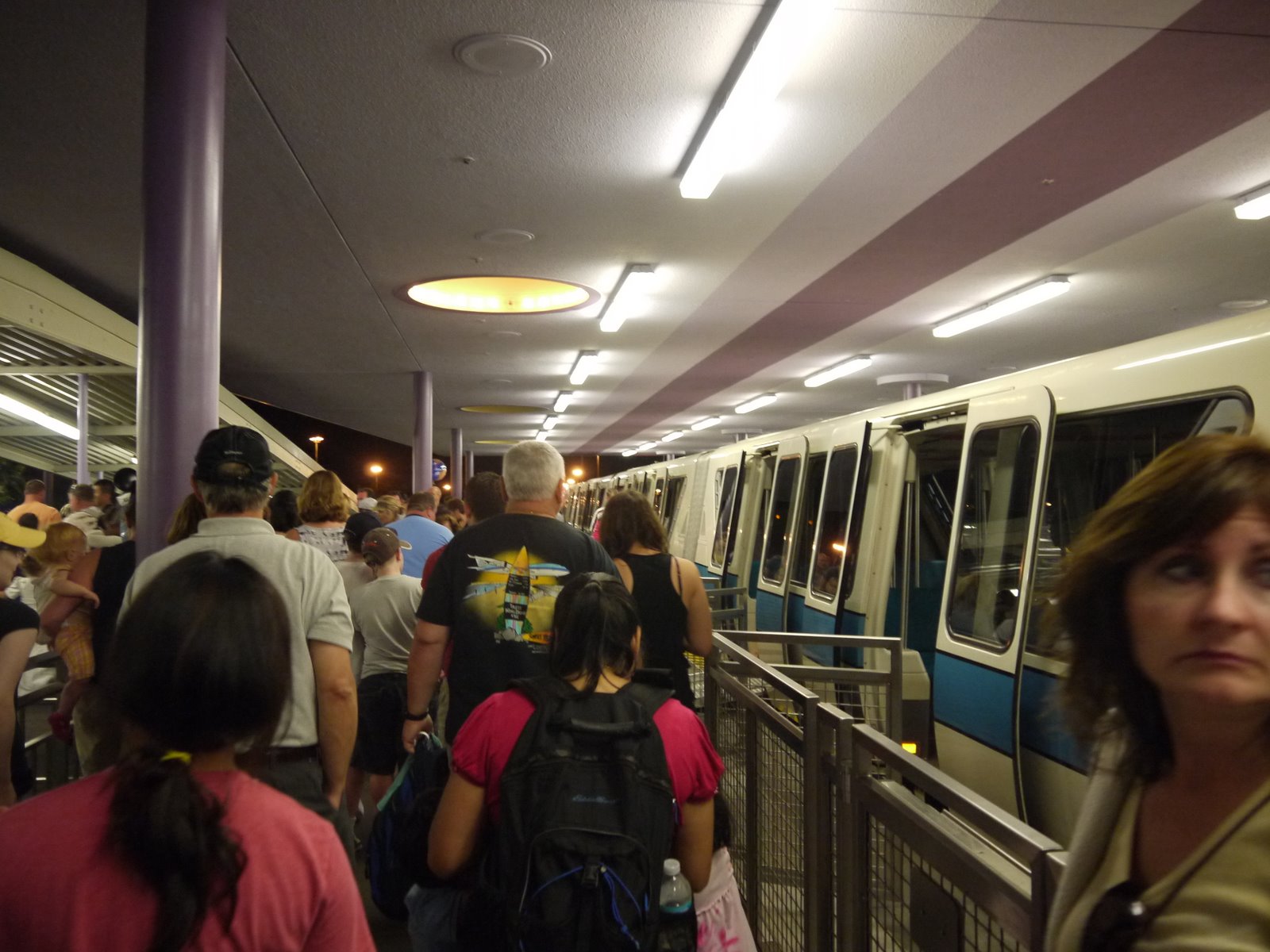
This is the monorail that serves Disney in Orlando, Florida. I didn't really know anything about this system before visiting, and was quite surprised that it was far from being an amusement park ride as expected. It actually serves a vital function, linking the Magic Kingdom, Epcot and some other Disney attractions to each other and to the Transportation Center. Trains run every couple of minutes and were packed. I was very impressed by the PA system on board which told us exactly why we were waiting for a few minutes just before our station (one of the trains was being switched to the Epcot route). All in all quite an experience.

Monorails can work in very dedicated situations like this - there's a similar short system at Orlando International Airport for example, but must cost a good deal more than conventional rail. A high capacity tramway would probably do the same job at a half the price - but you would lose the experience of seeing everything from an elevated position.