Showing posts with label Switzerland. Show all posts

Thursday, 23 March 2017

Climbing the Easy Way

Montreux


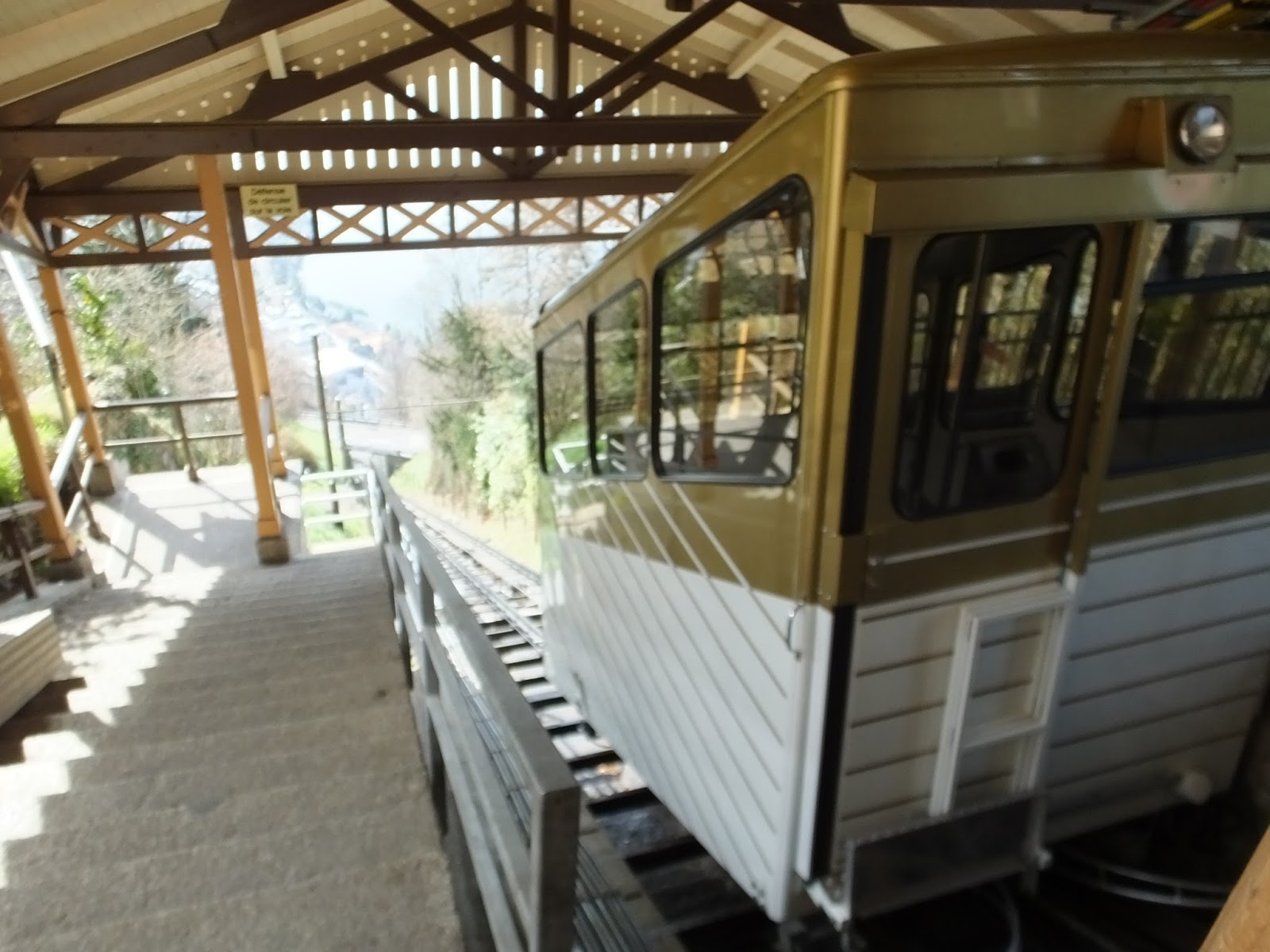
Funicular at Territet


The funicular trip to Glion


Glion-Montreux train (ex Rochers-de-Naye)


The view from the Buffer de Gare


The trip down from Glion to Montreux


Montreux station

(All pics 15.3.2017 copyright Steve Sainsbury/Rail Thing)


We just spent a brilliant 3 days in Montreux, on Lake Geneva. On day one we did a short trip up the mountain, all was free using the City Card you get from the hotel. First stage was the short ride to Territet, although we could have gone by trolleybus. Then under the SBB station to the adjacent by separate funicular station. The funicular was waiting (there's one every 15 minutes) and we were soon climbing up the mountainside. The funicular station at the top (there is one intermediate station) was right next to the railway station. We quickly found the Buffet de Gare and spent nearly an hour there with cakes and beer before catching the next rack train down the mountain. After a nice run through the hillside old town of Montreux we reached the main station at Montreux. From there we had the choice of local train back to Territet, the trolleybus or a walk back. We chose the latter. In season there is also the option of a boat back to Territet pier.

All in all a nice two or three hours in unusual warmth and bright sunshine.

I took my very first Swiss photo back in Montreux in 1975. Rather than staying in a lovely four star hotel with a balcony overlooking the lake I'd been sleeping on the trains. Rather than a nice breakfast in the Buffet I'd had a loaf's worth of cheese sandwiches in my rucksack to keep me going for a week! Interrailing was fun but could be hard at times!

Shots from 1975


(All 20.7.1975 copyright Steve Sainsbury/Rail Thing)

Friday, 6 January 2017

Aigle metre gauge in 1977


The station for the three metre gauge lines was very primitive. Nowadays trains arrive at modern platforms!


The AL's rack section seen from the street running section by Aigle Depot station.


Aigle Depot.


Leysin train street running in Aigle.


AL202 at Aigle.


AOMC train on the now closed street section in Aigle.


The now closed AOMC line at Aigle - AOMC trains now continue alongside the SBB main line before picking up the original route outside Aigle.

(All pics 15.2.1977 copyright Steve Sainsbury/Rail Thing)


My first trip to the continent in winter was in February 1977. The first port of call was Aigle with its three street running metre gauge railways, these shots were all taken on the morning of 15 February.

Forty years on there are a few changes. The old 'station' at Aigle, in 1977 just a series of sidings with a few signs, has now been replaced by a modern platformed station alongside the main SBB station. The short street running section of the Aigle-Ollon-Monthey-Champery (AOMC) has now gone, the line now follows the main line for about a kilometre out of Aigle before picking up the old route. The vehicles have gradually been replaced by more modern units, though many of the older units survive, some in service, some used on specials and a few just hanging around.

In 2017 Aigle is still a great place for the rail enthusiast to visit. All three metre gauge lines are busier than ever, and there are still a few streets in Aigle where regular passenger trains pass every hour. The main line station is thriving with plenty of locomotive hauled passenger and freight trains.

Sunday, 13 December 2015

Aigle to Leysin (Switzerland)

FACEBOOK - RAIL THING SUISSE - AIGLE-LEYSIN

RAILFILE - AIGLE-LEYSIN

Aigle–Leysin railway

From Wikipedia, the free encyclopedia

Aigle–Leysin railway
Transport Publics du Chablais logo.svg
Transports Publics du Chablais - 362 - 01.jpg
Overview
TerminiAigle
Leysin, Switzerland
Operation
Opened1900-1915
OwnerTransports Publics du Chablais
Operator(s)Transports Publics du Chablais
Depot(s)Aigle
Technical
Line length6.209 km
Track gauge1,000 mm (3 ft 3 3⁄8 in)
Electrification1500 V DC
Highest elevation1,047 m (3,435 ft)
Maximum incline23 %
Rack systemAbt

All three narrow gauge lines start outside Aigle CFF station: here in 1979
The Aigle–Leysin railway (French: Chemin de fer Aigle–Leysin, AL) was the earliest of the narrow gauge line in the Chablais area of south west Switzerland. The line was opened on 5 May 1900, a1,000 mm (3 ft 3 3⁄8 in)-gauge cog-wheel railway using the Abt rack system.
Nowadays it is joined in Aigle's main railway station by express trains of the Swiss Federal Railways together with those of three other, local, narrow-gauge railways: the Aigle-Ollon-Monthey-ChampéryRailway (AOMC), the Aigle–Leysin Railway and the Aigle-Sépey-Diablerets Railway (ASD).
[1]History

Compartment coach with compartment for lying patients CF2 21 at the Blonay–Chamby Railway (BC) in Chaulin at Summer 2010
  • 5 May 1900 : opening of the section from Aigle CFF station - Grand-Hôtel des Bains (Aigle).[2]
  • 5 November 1900 : opening of the section from Grand-Hôtel des Bains - Feydey (Leysin)
  • 1912 : The line between Leysin-Village et Leysin-Feydey is doubled
  • September 1915 : Extension of the line to the current terminus at Leysin-Grand Hôtel.
  • In 1946, the rolling stock was renewed, and the traction current voltage was changed from 650 to 1300 volts. This allowed the journey time to be reduced to around 30 minutes.

The route

The Aigle–Leysin railway line is 6.5 km (4.04 mi) long and rises 1,047 m (3,435 ft) from its terminus outside the main line station in Aigle to its summit at the Grand Hôtel at Leysin. The first 1 km of the route is through the streets of Aigle from the railway station to the railway depot where the train reverses to enable the powered vehicle to be at the rear of the train for the uphill journey, normal working on a rack (cog-wheel) railway. From this point the line climbs steeply through the vineyards, the steepest gradient being 1 in 4.3 (23%).
The operating voltage of the line has changed four times, increasing from 600 V DC at opening, first to 650 V DC, then in 1946 to 1300 V DC, and later to the present operating voltage of 1500 V DC.

Mergers

In 1975 the four local railway companies, Aigle–Leysin, Aigle–Ollon–Monthey–Champéry, Aigle–Sépey–Diablerets and Bex–Villars–Bretaye (BVB) merged to form a single operating company, known as the Transports Publics du Chablais (TPC). This brought about increased co-operation between the companies in the provision of community-based services.

Federal involvement


The line leaves Aigle as a street tramway

The route now operates as TPC line A
In 1985, the Federal Government informed the Aigle–Leysin Railway, and other privately operated railways, that it would cease all funding the following year, however they renewed a federal concession for a further period of 50 years. An agreement was signed between the Canton of Vaud, the communities served by the railway and the Aigle–Leysin Railway and its partners to renew rolling stock and upgrade the track.
In the mid-1990s, faced with greatly increased operating costs, the Canton of Vaud and the communities served by the railway petitioned the Federal Government to revoke its 1985 decision. The Federal Government did so and in 1996, recognizing the importance of this regional line as a public transportation carrier, awarded the line with a contract to provide a public transportation service. This brought about, in 1999, talks which resulted in the founding, the following year, of Transports Publics du Chablais as the parent body of local public transportation with the four local railway companies as founding members. The railway now operates as line A under the TPC banner.

Locomotives, railcars and rolling stock

The line owns just two locomotives. Their class He 2/2, built by SLM /SIG in 1915 was rebuilt in the company workshop during 2006/7, and has returned to service in near original condition and in its original red livery. They also have a 1949-built class Te 2/2.
The "automotrices" (railcars), painted in a light chocolate and cream livery, are, with the exception of No. 201 which is a class Arseh 2/4, of class BDeh 2/4. The company also owns 5 "Voiture Pilote"(driving trailers) of class Bt and retains 2 older coaches, class B2 for historic trains.
Details from official stock lists, May 2006 and personal observations 2006-2009.
No.NameClassBuilders Details.Date CompletedNotes
12He 2/21915Static monument, En Chalex
101Te 2/2Reb. AL1949Rebuilt 2006/7, returned to traffic, 2008. Out of service, Les Diabrelets, Sept 2009.
201Arseh 2/4SLM/BBC1946Converted to 1st class Restaurant Car
202BDeh 2/4SLM/BBC1946
203BDeh 2/4SLM/BBC1946
301AigleBDeh 2/4SIG/SAAS1966
302LeysinBDeh 2/4SIG/SAAS1966
311YvorneBDeh 2/4Vevey/BBC1987Ex-No. 303
312OllonBDeh 2/4Vevey/BBC1987Ex-No. 304
313La BerneuseBDeh 2/4Vevey/BBC1993Ex-No. 305
351BtSIG/SAAS1966
352BtSIG/SAAS1966
361BtACMV/SIG/BBC1987Ex-No. 353
362BtACMV/SIG/BBC1987Ex-No. 354
363BtACMV/SIG/BBC1993Ex-No. 355
B21900
B21955

Abbreviations

Sunday, 20 September 2015

Switzerland's Frauenfeld-Wil Bahn


Above Frauenfeld and (bottom) Frauenfeld Stadt


Wil

(All pics copyright Steve Sainsbury/Rail Thing)


A fairly typical Swiss light railway which connects two towns and two SBB stations is the unpretentious Frauenfeld-Wil Bahn. It runs through flat scenery with nowhere spectacular en route, but the section of street running through Frauenfeld is nice! In 1987 the station at Frauenfeld Stadt was a nice substantial building  hopefully it's still there!

The line is metre gauge.


The Frauenfeld–Wil railway (German: Frauenfeld–Wil-Bahn, FW) is a metre gauge (3 ft 3 3⁄8 in gauge) railway line[1] in Switzerland, which connects the town of Frauenfeld in the canton of Thurgau, to the town of Wil in the canton of St. Gallen, following the valley of the Murg river. The line is owned and operated by the Frauenfeld-Wil-Bahn AG, forms part of the Tarifverbund Ostwind, and operates as service S15 of the St. Gallen S-Bahn.
Plans to build a tramway between Frauenfeld and Wil were first made in the early 1850s. The rail line opened in 1887, and was electrified in 1921. Around 1.25 million passengers use the line every year.
Locals call the train "Wilerbähnli" or "Wiler Bähnli".

Operation

Trains run every 30 minutes, requiring 3 trains in operation at once, with trains crossing at the stations of Matzingen and Schweizerhof.
In 2011 the railway company ordered five new ABe4/8 low floor trains from Stadler Rail, to replace the old trains. However, there are plans for a 15 minutes interval in future and therefore some of the old trains will be retained. The first train was delivered in March 2013 and was tested for 3 months. It went into regular service on 26 June 2013.

Stations

15 stations are served by the line.
StationkmAltitude
Frauenfeld17.44404.6
From Frauenfeld there are trains to Winterthur and Weinfelden.
Frauenfeld Marktplatz16.85417since 1996
Lüdem15.13423
Murkart13.92431
Weberei Matzingen12.62440
Matzingen11.49447
Jakobstal9.81460
Wiesengrund9.01465
Wängi8.27470
Wängi GB (Service Station)7.95474
Rosental6.5487
Münchwilen Pflegeheim4.66509
Münchwilen TG3.89516
Schweizerhof (Service Station)2.66530
Wil0.00570.8
From Wil there are trains to Winterthur, Weinfelden, St. Gallen and Wattwil.

Freight Traffic

Freight trains ran on the line from 1907 until the early 2000s. This included transporter wagons from 1977 onwards.

Saturday, 15 August 2015

Waldenburgerbahn


Liestal 25.5.1987


Altmarkt 25.5.1987


Waldenburg 25.5.1987


Oberdorf 25.5.1987 

(All pics copyright Steve Sainsbury/Rail Thing)


The Waldenburgerbahn runs on the very narrow gauge (for Sswitzerland) of 750mm (2'5½") and is situated in Canton Basel-Landschaft. The line is 13.1km (8.1 miles) long, running from Liestal (junction with the SBB) to Waldenburg. There are intermediate stops at Bubendorf, Hölstein, Niederdorf and Oberdorf.

The line is operated by the Waldenburgerbahn AG and is the only normal passenger line of this gauge in Switzerland (though some industrial and funicular lines use it). It was steam operated until 1953.

The original concession for the route was granted on 18 June 1871. The original plans included an extension from Waldenburg to Langenbruck, but this section was not built. The railway opened throughout on 30 October 1880.

In 1909 plans for a longer extension from Waldenburg via Langenbruck to Balsthal, plus a connection from St Wolfgang to Mümliswil, were applied for but World War I intervened and this extension also didn't make it (together with plans for conversion to metre gauge).

Electric operation of the line started on 26 October 1953, using 1500v DC. The original 1953 stock has since been replaced by seven railcars and ten control cars acquired between 1986 and 1993.

The line operates mainly on a roadside reservation with street running in places, There are now eleven intermediate stops and six passing places, allowing a fairly intensive half hourly service to be operated, with additional trains in peak periods.

Tourist steam trains are operated from spring to autumn using 1902 built locomotive number 5, Gedeon Thommen. This loco had previously been plinthed at Liestal station between 1961 and 1980.


Thursday, 6 November 2014

a trip down the mountain


Foggy Leysin Village station.


Past vineyards on the outskirts of Aigle.


Starting on the street track past Aigle Depot station.


Aigle Place du Marche halt.


Tight squeeze!


Station approach.


Entering the station forecourt area.

All pics copyright Steve Sainsbury/Rail Thing 14.9.2011


You never really get used to it, and I must have done this trip 40 times! The Aigle-Leysin line starts from a brand new station adjacent to the main SBB station in Aigle and immediately runs on street to Aigle Depot station, just over a mile, before reversing and taking the rack up the mountainside to eventually reach, via a couple of wayside halts, the four stations in Leysin.

The street running includes a stretch along a narrow one way street which always delights! Whether from the train or from the pavement it's always entertaining.

The line is busier than ever and replacement of the street running section is not even on the radar so you can safely wait a little longer before visiting. The line itself is absolutely essential, taking just 20 minutes to link Aigle and Leysin, a much longer journey both in miles and time if you're unfortunate enough to have to drive!

There are two other metre gauge lines at Aigle, the long Aigle-Ollon-Monthey, Champery line which has lost its street running stretch in Aigle - it was a simple job to lay a new line along the SBB route and regain the original route just outside town. There is however street track remaining on this line in Collombey, plus a decent amount of roadside running. The other line is the Aigle-Sepey-Diablerets route which still uses street running to exit Aigle, and also has a very rural roadside stretch (traversed twice on every journey) into Le Sepey.