SELSEY TRAMWAY
Chichester station.
Chichester station.
Chalder remains.
Chalder
Selsey Town, one of Selsey's four stations.
Selsey engine shed.
Canal bridge at Hunston.
1910 floods at Sidlesham.
Sidlesham.
The only piece of track currently on the line.
I discovered the
Selsey Tramway reading through library books in about 1969. I remember seeing a picture of a derelict engine outside a derelict engine shed, and quickly found a map with the route on. Next step was a long cycle ride from Littlehampton with my brother, at the time I had no idea whether the line was still there or abandoned. Shattered we reached the line near Sidlesham and of course could hardly tell where it had run.
So I found out more about this eccentric line with its multitude of stations and big ideas which came to a shuddering halt in 1935, 34 years before I discovered it. It's funny to think that 44 years have since passed since I first found out about the line, yet back then it seemed like something out of ancient history! What does that say about me?
I made a few more trips over the years, usually taking the train to Chichester then walking south. There was the station platform at Hunston and the remains of the canal bridge, the two connected by a footpath along the route.
Many years later when I lived in Bosham I wrote a letter to the local paper after it had run an article on the terrible quality of the road from Selsey to Chichester, suggesting the line be rebuilt. Amazingly in the very same edition there was a totally separate piece on a meeting to discuss the very same thing! Obviously I went along and my reputation (thanks to the letter) had preceded me and I was (rather reluctantly on my part) elected to be vice chair!
The group flourished but unfortunately I had to move away from the area and I've not been able to find any references to it on the web, which suggests the group folded. It was way ahead of its time, we didn't even mention Peak Oil or Climate Change back then! The plan was a new build route using PPMs for passengers and heavier diesels for freight. Perhaps it was this plan that led much later to the germ of the idea for the New S&D.
Obviously a rebuilt Selsey Tramway would be very successful. There would be few engineering works, the line would help to quieten the road and would bring loads of visitors to the town who currently just avoid it (because of the road!) It would give Selsey and the villages in between a modern and resilient transport link, which could also extend to the Witterings. The only downside is the vulnerability to most of Selsey Bill (and most of the tramway route) to climate change induced sea level rise. But the biggest problem with the tramway? It was 150 years too early!
More info (from Wikipedia)
The
West Sussex Railway opened in 1897 as the
Hundred of Manhood and Selsey Tramway, running from
Chichester to
Selsey, in West Sussex. It was built to standard gauge, but as a tramway in order to avoid having to comply with regulations that covered railways. It later changed its name to the West Sussex Railway (Tramway Section). It was engineered by
H. F. Stephens, later Colonel Stephens.
It suffered from the inundation of December 1910 near Pagham, and had to carry out work to raise the level of the railway in the area.
Successful in the era before the First World War, it gradually declined in the face of road competition; it responded by the most stringent economies, and it introduced petroleum fuelled rail cars to operate the service.
It finally closed in January 1935; little remains of the railway.
Origins
The passing of the Light Railways Act in 1896 prompted local businessmen to consider whether a light railway connection to Selsey could be made. The town lies on the coast about 8 miles south of the City of Chichester. As they prepared their scheme, they found that it would be possible to get authorisation much more simply under the Railway Construction Facilities Act, 1864. By structuring the line as a tramway, the numerous public road level crossings would not require the special safety arrangements required for railway operation, and accordingly they formed the Hundred of Manhood and Selsey Tramway. The Company was incorporated on 29 April 1896.

Lift bridge at crossing of the Chichester Canal
H. F. Stephens was appointed as engineer to design the line and supervise construction; this was his second such role, after the
Rye and Camber Tramway. His subsequent career pursued several very local lines often run on minimal finance; during war service he became (Lieutenant-) Colonel Stephens, by which he is better known.
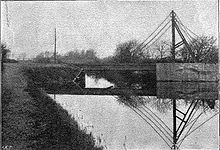
Lift bridge over Chichester Canal, 1897
The land was acquired from co-operative landowners without the need for compulsory powers, although this forced a slightly indirect route. It started from a point a little to the south of the
London, Brighton and South Coast Railway (LB&SCR) station at Chichester; it left westwards and immediately turned south, running broadly southwards to Selsey itself, a distance of 7¼ miles (11.7 km). Just south of Chichester, the line crossed the Chichester Canal, which still had some small traffic volume passing, and a simple manually operated lifting bridge was provided there.
The contractor for the construction needed a locomotive for the work, and the locomotive was moved on the public road to get to the line south of the Chichester Canal. It was hauled by a traction engine, and it ran on rails placed on their sides in the roadway; workmen progressively moved the rails to the front of the engine as it made its slow movement. The locomotive was later named Chichester.

Whitechurch's 1897 photograph of the road transfer of the locomotive
Whitechurch describes the event; referring to the Chichester and Birdham Canal (i.e. the Chichester Canal), he says:
I am able to supply a unique photograph of an incident that happened during the construction of the line owing to this canal. The engine had been brought down to Chichester and was much wanted on the other side of the canal, but as the bridge was not completed for traffic it was impossible to cross. The little locomotive, therefore, had to perform a slow and circuitous journey by road of over three miles, being hauled by a traction engine on rails, simply placed down on the road in front of the railway engine and taken up from behind it alternately.
The line was built to standard gauge, 4 ft 8½ in (1,435 mm), with Vignoles (flat-bottom) rails spiked to light transverse sleepers, "the whole of the line being ballasted with gravel, and, if I mistake not, a goodly bulk of sea shingle mixed therewith".
The line opened to Selsey Town station on 27 August 1897 and it was extended to Selsey Beach in 1898. The construction and land purchase had cost £21,570 and rolling stock had cost £3,268.
Operation
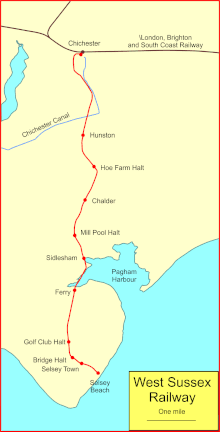
Map of West Sussex Railway
The first passenger coaches were newly built bogie vehicles with open verandas at the end; one was built by Hurst Nelson, and three by Falcon of Loughborough. About 1900 another new coach of similar design was acquired from Hurst Nelson.
[2]

Hunston station in 1897; note the boy on the engine-water tower, waiting to operate it
The stations on the line were:
- Chichester; the station was a short distance south of the LB&SCR station
- Hunston, where there was a level crossing and a short siding; there was also a brickworks with an independent loop siding north of the station for some years;
- Hoe Farm [Halt]; this was a private halt for the farm owner;
- Chalder ; this was the closest station to Sidlesham village; the access was over a private farm road, and the Company paid the landowner £2 per annum for the wayleave;
- Mill Pond Halt; opened 15 October 1910 and closed May 1911; reopened 9 July 1928;
- Sidlesham; the station name seems to have been spelt Siddlesham at first; this was an ancient spelling of the village name, although the 1880 Ordnance Survey Map uses the modern spelling; the station was some distance south of the village. Suffering from the 1910 inundation, the station was closed from 15 December 1910 until June 1911; the track level was raised by about four feet (1.2 m) at the station level crossing; there was a loop siding here;
- Ferry; Butt names this Ferry Siding Halt; Cobb says Ferry Siding at first and renamed Ferry in 1911;
- Golf Club Halt; this was private
- Selsey Bridge ; the main road crossed the line here, the only road bridge on the line; there was a short siding and, some time after 1911 a brick works had a private siding;
- Selsey Town; renamed Selsey from 1911; the engine shed was located here, with a goods siding and run-round loop;
- Selsey Beach; opened 1 August 1898 and closed October 1904; the train service may have operated in summer only; there was a simple run-round loop and single platform.
In 1910 there were seven trains each way on weekdays (one extra on Mondays) and three on Sundays. Journey time for the 7¼ miles was 30 minutes.
Whitechurch gave a description of a trip on the line in 1897:
One car stood by the little platform, ready to start. ... This was a third class car. A first class stood in a siding. ... Another car of which I caught a glimpse at Selsey completes, I believe, the "passenger rolling stock" of the little railway. ... The Company own two engines, the "Selsey" and the "Chichester", the former for "passenger" and the latter, a "six-wheels coupled" for "goods" traffic. The "Selsey", a trim-looking little side-tank locomotive, is painted dark blue with a red lining ... The boiler is surmounted with a handsome brass dome on which are two spring balances [for the safety valves], while a neat copper ring is an adornment to the chimney.
Before we got away on the journey, a very remarkable operation in shunting had to be performed, albeit it was commenced two minutes after the time for starting. Two trucks were brought in from a siding, and so manipulated with engine and by hand, that finally one was attached in rear of the car, and the other in front of the locomotive!
[Later we came] to Hunston Station, a tiny iron building with a little platform, but a most important point of the line, in that it is the coaling and water depôt, and supplies of both were taken in by the engine, the train backing to allow this to be done, so that our car stood right across the main road during the operation. ... Chalder, another little station was reached at 10.58. We left our rear truck in the siding here ... [At Siddlesham] we performed some marvellous shunting operations, which occupied six minutes, and which resulted in our entering on the last stage of our journey, with three trucks in front of the engine and two behind our carriage—the very best example of a mixed train it has ever been my fortune to behold! ... Just before reaching Selsey we passed through the only cutting and under the only road-bridge the line possesses, pausing a few minutes to get rid of our five trucks at a siding.
About midway on the journey home, I, who was seated in the front compartment of the car, saw a red flag being violently waved a few hundred yards ahead. ... as the train slowed down, the individual in question, a stalwart, gaitered farmer, removed the danger signal from his stick, and calmly came aboard the car, doubtless thanking his lucky stars for the little railway that ran within a few feet of the garden of his house.
There were no signals on the line; the train control system was
train staff and ticket with two sections, broken at Sidlesham.
Inundation of 1910

Bridge over channel at Ferry
A fierce and prolonged storm took place in December 1910, culminating in a breach of the sea wall during the night of 15 December. 2000 acres (800 ha) of land were flooded, including the railway line north of Ferry. Part of the line was said to be under 12 feet of water.
During the inundation, trains ran from each end of the line, and a horse bus operated in the gap, from Mill Pond Halt to Ferry station. At this time the Company was relatively prosperous, and had the resources to raise the line by up to ten feet (3 m) over a considerable length.
After 1919

Picture postcard depicting the train
Following the end of the First World War, independent operators of road lorries, and, gradually, road passenger vehicles, became numerous, and the inconvenience of using the tramway became prominent: agricultural produce and supplies needed to be carted to and from the tramway station, and the thinly distributed population were more easily serviced by a road vehicle, especially when that could run to the centre of Chichester or direct to the LB&SCR station there.. Traffic declined seriously in the 1920s.
In 1924 the company changed its name to West Sussex Railway (Tramway Section) in 1924. Mitchell and Smith suggest that this was a preliminary to securing a takeover by the Southern Railway, the successor to the LB&SCR. The Southern Railway considered the matter but declined to proceed. Southdown Motor Services had been formed in 1915 and was running timetabled bus services locally, and increasingly passengers preferred to take the bus—at a higher fare—and passenger receipts declined further.
| Year | Passengers | Receipts |
|---|
| 1919 | 102,292 | £3,912 |
| 1924 | 31,352 | £949 |
| 1929 | 22,676 | £557 |
| 1933 | 21,088 | £427 |
During this period freight traffic remained relatively steady at about £2,000 a year.
Coaching stock
The initial coaching stock fleet consisted of three bogie saloon coaches from Falcons, acquired in 1897. A similar coach was purchased from Hurst Nelson about 1900.
Finally, in 1931 two six-wheel coaches were acquired from the Southern Railway, probably for summer Saturdays when the railcars would be inadequate; they had been built for the LC&DR.
Railcars

Picture postcard depicting the train
In 1921, Stephens was seeking means of reducing operating expenses, and a trial was made of a Wolseley-Siddeley petrol railcar on the line; this did not immediately lead to adoption, but in 1924, acquired two railcars built on Ford Model T chassis, with bodies by Edmunds of Thetford. They operated together, back-to-back with a truck for luggage and parcels between them; they had rails on the roof to contain additional parcels stowed there.
Two more railcars were acquired from the Shefflex Motor Company of Tinsley in 1928; they too operated as a unit with a truck between. The railcars were provided with a crude timber buffer beam in front of the radiator, as protection.
Closure
The half mile of track from Selsey Town to Selsey Beach was out of use by the end of 1908. (Butt says October 1904.)
The line was closed in January 1935.
Steam locomotives
Sources for the above table include Kidner, Woodcock and Mitchell and Smith.
The first Chichester arrived with the name Wembley having worked there previously, and the engine continued to be known by that name for some time.
Archaeology

The remains of where the railway crossed the Chichester canal
For the modern railway explorer this is one of the least rewarding lines to trace as the formation was almost completely at ground level, and almost nothing remains except a half mile section alongside Pagham harbour where the track was raised following the inundation of 1910. A section of about a quarter of a mile, now a farm track between Pagham Harbour and the Selsey Golf Club and a quarter of a mile section (now a public footpath) west of Hunston Village can be traced. The northern end of the latter ends at the abutments of the now defunct Tramway bridge across the Chichester Canal. A short section of trackbed is now a footpath from north of the Chichester Canal to Stockbridge Road, Chichester. The platforms of Hunston and Chalder station can also still be located in fields although badly overgrown.
Failed proposals
In 1913 the directors proposed a light railway extension from Hunston to West Itchenor and East Wittering. However the First World War put paid to the idea.
This line was surveyed by the builders of the
Romney, Hythe and Dymchurch Railway in the early 1920s when they were looking for somewhere to build their miniature line which now runs in Kent. Apparently, despite being otherwise ideal for their purposes, the line was discounted because of the number of road crossings which would have been prohibitively expensive to either gate or bridge. The
Southern Railway also surveyed it for takeover and improvement in the early 1930s but decided against both.
Local colour
It was known locally as the Selsey Tram. It was also sometimes called "The
Siddlesham Snail" after one of the villages having a station of that name. Sidlesham station's nameboard originally perpetuated the old spelling "Siddlesham". A song was written criticising the line which verse went
- "The Siddlesham snail,
- the Siddlesham snail,
- the boilers burst,
- she's off the rail,
- the Siddlesham snail!"
Between the World Wars a number of life-expired main line railway coaches were acquired by private individuals for the purpose of converting them to dwellings on the shore at Selsey. In many cases these vehicles made their final railway journey over the West Sussex Railway to Selsey.
Accidents
On 3 September 1923, the 8:15am train to Chichester derailed near Golf Club Halt, killing the fireman, H. Barnes, and injuring the driver, C. C. Stewart. None of the few passengers were injured. The locomotive, Wembley and the three coaches left the track. The inquest returned a verdict of accidental death, but the jury expressed the opinion that the Chief Engineer of the Company was indirectly to blame, as there was evidence of neglect in the upkeep of the track.


