Showing posts with label Alresford. Show all posts

Sunday, 16 February 2014

bluebell branches out


(Photos copyright Steve Sainsbury/Rail Thing) 


I grew up in Sussex and the Bluebell was a constant presence to me. Loads of people talked about it, everyone I knew visited it and I got to go every year or so. I even joined and volunteered and spent one frosty day working on the track, but back then my only way of getting there was to go to Haywards Heath and walk or go by motorbike.

Back then of course it was a lovely, rural four mile long classic branch line, but things have changed a lot since then! I have done the extension to Kingscote but yet to do the East Grinstead stretch, but I have my eyes on a Steam Tours trip from Alresford to Sheffield Park in October!

The Bluebell has always been rather ahead of the game and have cleverly built their Network connection before oil supplies get tight, which will allow them to continue to bring in visitors and volunteers long after cars are just a fading memory.

And less than a year after making that Network link they are talking about their second! They have owned much of the Ardingly branch for years. Now with East Grinstead reached they can start to redirect their energies towards Haywards Heath.

The Haywards Heath-Ardingly-Horsted Keynes route was always an odd one. It was electrified for a start! It also had a very odd destination - the huge former junction station of Horsted Keynes stuck in the middle of nowhere. No doubt it survived the closure of the main line from Lewes to East Grinstead because it was electrified, but it did eventually close in 1963, leaving the Bluebell isolated from the Network. Most of the line remained open for freight, and is still used by one stone train a day.

Bluebell's plans are to extend to Ardingly first, and then enter into a running rights agreement with the Network to allow them to reach the main line at Haywards Heath. Fortunately the Ardingly route has a separate line into Haywards Heath and there is room for a separate Bluebell station alongside the Network station. Land for this is already being looked at.

The Bluebell is estimating ten years (ie 2024) for this to be completed. When rebuilt this route will give an emergency Brighton-London route, and will also tap dkirectly into the south coast's large population of residents and holidaymakers.

There have been calls to make this route third rail electric, which would be fantastic, but there are health and safety issues, apparently. (Though surely this would apply to the whole Network??) I would love to see the units I grew up with on the south coast running in preservation. We shall see.

And after Haywards Heath is reached? I suspect that the Bluebell will at last start to look south of Sheffield Park, and rebuild that little lost stretch to Lewes. This will increase the flexibility and resilience of their network and will tap directly into traffic from Lewes, Eastbourne and that whole area of East Sussex. It will also create yet another possible diversionary route for the BML.

From a schoolboy's crazy dream in the 1950s to an embryonic network covering a big slice of rural East Sussex, the Bluebell is a magnificent example of the possible and should inspire all of us!


Barcombe 4.7.1977 (copyright Steve Sainsbury/Rail Thing) - the final piece of the jigsaw!

Wednesday, 23 January 2013

alresford 1976


(All 24.6.1976 copyright Rail Thing)
 
Back in 1976 Alresford had not long been part of the Watercress Line and I don't think trains were running at this time. Whilst there is a Southern tender engine all the other locos on site were industrials. It's sometimes easy to forget that many of today's flagship lines started off very small and some didn't even make it (though 97% did!) Of course back in the 70s, or at least in the first half of the decade, there were still a few lines being closed by BR, which is perhaps easier than rebuilding a line from the trackbed up, but remember that the track through Medstead HAD been lifted at this time (photos will follow!)
 
When I hear people today questioning the viability of new build lines I think they need to remember that some of our biggest and busiest lines nearly didn't make it. Swanage struggled for years and all the track was lifted. The Kent and East Sussex had terrible problems with level crossings. The Festiniog lost part of its line under a reservoir. All were overcome.
 
The Third Wave of railways is now happening. These are lines that mainly closed before 1970 and have been lifted. Most of these new schemes have a community railway element, some (like the Waverley) have even been taken over by governments and built. The S&D of course falls into this category and who would have thought that this line now has a group that plans to restore the whole route, and that there are now five separate restoration and operating sites along the line?
 
I think it's a good idea to sometimes look back at the early days of some of the stars of the heritage (1st and 2nd wave) restorations!


Saturday, 10 March 2012

Medstead and Four Marks 1976

(Both copyright Rail Thing 24.6.1976)

The Winchester-Alton line closed on 5.2.1973. This line had been under threat for many years but it was still a surprise to see it go as it provided an excellent alternative route for Waterloo to Southampton and beyond trains when the main line was blocked or there were engineering works. Surely it would have made more sense to electrify it? That way Alresford would have become a proper commuter town. Strange days indeed.

Although a preservation group was soon formed much of the line was still lifted. So in 1976 this delightful intermediate station was railless and resembled many other closed stations at the time.

The line has of course resurfaced as the Watercress Line, gradually being extended back towards Alton from Alresford, and now has a main line connection at Alton, where the electrified route to London begins. Today Medstead and Four Marks has rails again and sees plenty of trains, but sadly few if any of them are 'real' in the sense that they carry ordinary people just wanting to get somewhere, and there's no freight traffic. The section west from Alresford with the intermediate station at Itchen Abbas is still closed, listed and dead.

But surely in the future this strategic route will be rebuilt and through trains will run again, taking pressure off the main line via Basingstoke. It needs to be electrified and take its proper role as a transport artery.

Sunday, 21 March 2010

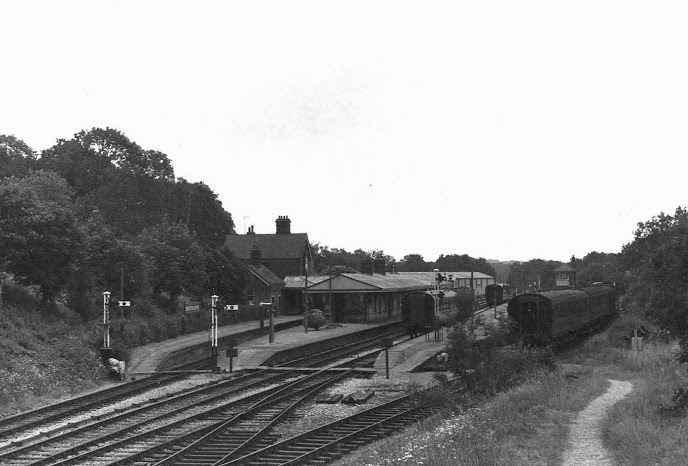
watercress line in january 1973


Medstead and Four Marks.


Ropley.


Alresford.


Winchester Junction.
(All 4.1.1973)

The Winchester to Alton line closed on 5.2.1973. It should of course have been electrified and used as a diversionary route for the Southampton main line, just as it was in 1967 when the main line was being electrified. Fortunately most of it has been reopened, as a heritage line, but I personally believe that the 'lost' section, which includes Itchen Abbas station, will be restored in the coming years and the line will once again serve a genuine function as part of our expanding network.

But back in 1973 the world was a very different place and people genuinely thought that railways had had their day! So the line closed after years of no investment or marketing.

It was a misty day and I was using a cheap camera, but I think this works well in the photos, giving the line an aura of melancholy which matched the mood of the times.
Posted by Picasa