Showing posts with label Somerset. Show all posts

Saturday, 29 April 2023

Somerset and Dorset Delight


It's always a pleasure getting the excellent S&D Telegraph, the house magazine of the Somerset and Dorset Railway Trust down in Midsomer Norton. It's a high quality magazine but the best thing about it is the content, which is superb. This current issue (number 62) contains articles on a walk along the whole route in 1976, the 9F that the group is purchasing for eventual use at Midsomer Norton, general articles on all aspects of the rebuilding and maintaining of the line and reports on volunteers.

The S&D revival, in my opinion, is the most important thing in UK rail preservation. There are stirrings of rebuilding at several points, from Midford in the north down to Spetisbury in the south. Midsomer Norton and Shillingstone are both proceeding with establishing working heritage railways.

I worked many years at Midsomer Norton and saw huge progress from a trackless station to an almost mile long route (including double track!) and a fully rebuilt signalbox and greenhouse. I had to give up due to health issues but I still follow developments closely, mainly through the Telegraph magazine.

So the station is restored, the line plans to extend both north and south and a big locomotive is coming. The group need to break out from the Misdomer Norton South site and start to build a premier league line where big locos like the 9F can really see some proper work.

I'd urge anyone with an interest in the S&D to join the group at Midsomer Norton and help make this happen, whether by volunteering, supporting financially or just spreading the word!

The group can be contacted via their website at www.sdjr.co.uk and emailed at general@sdjr.co.uk


Wednesday, 9 August 2017

East Somerset Railway - 6.8.2017


It's almost becoming a tradition, my birthday trip to the East Somerset Railway! This year was even better as, purely by chance, the dining train was running. This was a superb experience, great food and atmosphere and excellent service throughout. Highly recommended!!


After the meal I trekked round Cranmore station trying to get photos. I've never found this line that easy to photograph, but the shots are there if you look for them! I also got a bargain in the shop - a secondhand copy of The Longmoor Military Railway (David & Charles) at just £3.

Tuesday, 24 November 2015

Gartell Railway work day 22.11.2015

Activity from last Sunday at the GLR. 'Out the line' with four teenagers and two, er... 'mature' types! The four lads did a great job, and their ages added up to just slightly more than mine, and just slightly less than C.J's. (John Penny)


A view from the 'other side' just prior to us heading out the line. The banner is off No. 14 (section signal) seen on the corner ahead.


Red set 101 gets the 'Santa' boards ready for a school bazaar on December 5th. We're just running the trains so know no other detail. Come along and support it anyway!!


Chandler gets stuck in on Common Lane No10 with the replacement signal head. Although only 16 years old there is not much he can't do in the GLR wiring department!


Meanwhile here is Chandler's Grandad working on the replacement signal head on the other 'road' at Common Lane. Along with Matt 1 they're tightening their nuts.


Down at the 'End of the World' the lads get stuck into the vegetation.


Matt 2 gets to grips with his big weapon.


C.J. sharpens up his tool.


What is it with blokes and bonfires? The dry detritus at the foot of the embankment is carefully burned off as Matt 2 is talked out of doing a headlong dive into the flames.


Having just had a look at the old cattle creep, I snapped the boys building up to the last bonfire of the day. Not the most exciting viewpoint but at least it is a new one!


The light is fading as we head for home to bath the innumerable scratches, remove the thorns from our anatomy and have a good soak in the bath to get rid of the smell of bonfire smoke.

(All pics, text and captions by John Penny at Gartell Railway).


The Gartell Railway has now finished running its regular trains for 2015. This is a great set of shots showing the really fun side of rail work - choppoing and bonfires! It's really good to see that the Gartell has a team of younger volunteers, something all lines need as older volunteers enter their dotage!

Thursday, 5 June 2014

Weston, Clevedon and Portishead Railway


WICK ST LAWRENCE


I was always fascinated by the Colonel Stephens railways. I was lucky enough to have grown up quite close to one (the Selsey Tramway) and at the other end of Sussex another Colonel Stephens' line was being restored - the Kent and East Sussex.

But one of the most fascinating of all Colonel Stephens lines was the Weston, Clevedon and Portishead Railway, which linked the three seaside towns in its title. It struggled on until 1940 but from a 21st century perspective it seems odd that it did ever struggle! The three main towns are busy seaside resorts and should have easily provided enough business. One issue was that all three towns had branches to the main GW line from Bristol to Exeter, and this may well have sucked a lot of potential traffic away. The station at Weston was inconveniently sited, it would have been far better if the original tram-style route into Weston had been operated. It was built but there were, even back then, objections, and the track was lifted without being used.

So the line struggled on under the weight of the issues above, and closed during World War Two, in 1940.

Today there is an active group that doesn't rule out rebuilding part of all of the route. If that goes ahead the chances are the new line would be more heritage than modern, which is a shame, but any railway is better than none at all. Imagine being able to catch a modern tram (or even a steam train) from Weston and taking a leisurely trip across the marshes through Clevedon and on to Portishead, where the old GW branch is now under restoration. What an extra attraction that would be for the resorts, which really do need a USP! As with most of the Colonel Stephens line, the WC&P was a hundred years ahead of its time ...


BUY SOMERSET'S LOST RAILWAY (profits to New S&D!)

Further information (from Wikipedia)

The WC&PR was originally proposed as a standard gauge tramway in 1884 by the Weston-Super-Mare, Clevedon & Portishead Tramways Company to link the three small coastal towns. The line was planned to run on the street along the Boulevard in Weston-super-Mare and from there off-road apart from numerous road crossings all of which were to be on the level. An Act of Parliament to authorise the construction of the railway was passed on 6 August 1885.

Building of the Weston-super-Mare to Clevedon section of the railway began in 1887 but due to various legal and financial problems, progress was very slow, and the time limit of the Act expired requiring further Acts to be passed on 25 July 1890 and December 1891. Due to these delays some of the track had to be re-laid before the line opened because sleepers had rotted. The track along the Boulevard in Weston-super-Mare was taken up before the line opened due to complaints from the council. The section finally opened on 1 December 1897. Two years after the opening, the tramway was designated a light railway and the name was changed to the Weston, Clevedon & Portishead Light Railway Company.

Portishead extension


The location of Clapton Road Halt near Portishead.

The extension to Portishead had been planned from the beginning, but financial constraints delayed its construction. It required another Act of Parliament, which was passed in August 1899, There were many objections to the proposed extension, one of which was that the line was to run through the streets in Clevedon. These objections were overcome, but a man with a flag had to lead trains across the street at 4 mph. The extension to Portishead was built as a light railway and opened on 7 August 1907.

Other features

Links to the Great Western Railway were provided at Clevedon and Portishead, and in 1915 a short branch to a wharf at Wick St. Lawrence on the River Yeo was built. Sidings served three stone quarries in the Gordano Valley.

Wednesday, 4 June 2014

Yatton 4.6.2014


(Yatton 4.6.2014 all copyright Rail Thing/Steve Sainsbury)


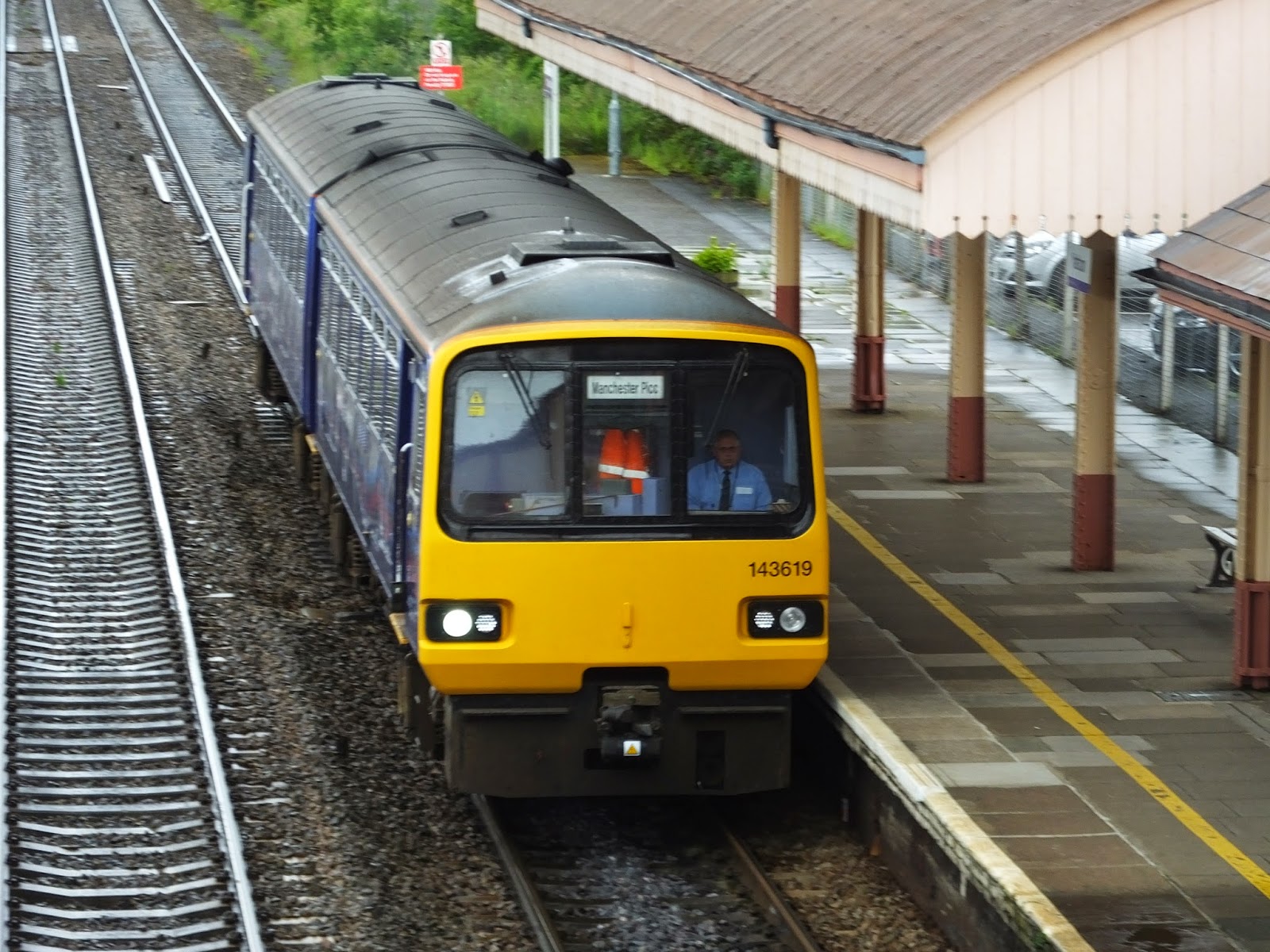
Spent a couple of hours at Yatton this afternoon, just snapping. I've been through the station many times by train, but this was the first time I'd actually stopped off there. In contrast to Bedminster, Saturday's outing, there  is still plenty of infrastructure left, including the iconic Clevedon bay canopy. Nothing particularly interesting went through, though a DMU showing 'Manchester Picc' on the front destination blind and 'Crewe' on the back was amusing.

I was chatting to a bloke on his way to Bangkok who remembered travelling on the Clevedon branch, which neatly takes me on to the history of this station. I often see it flying out of Bristol airport and it's clear from a few thousand feet up that the station was a junction with lines neatly curving off both to the left and right. The short branch to Clevedon closed in 1966, a truly stupid closure. It would be packed today and Clevedon would be a lot busier for it. The other line connected a string of towns to both Yatton and Witham on the Frome to Taunton main line. It served the toens of Axbridge, Cheddar and Shepton Mallet, and the city of Wells. It closed three years earlier than the Clevedon branch, and again would be a very busy route today. Both lines need to, and undoubtedly will, be rebuilt and link back to the Network. But for now Clevedon remains in deep sleep and the longer Cheddar Valley line has a temporary use as the 'Strawberry Line' cycleway and footpath.  I'm getting a bike in September when my brother-in-law emigrates to Taiwan, and look forward to taking it along this cycleway.

In fact Yatton has a lot of ex-railway promise in the area. As well as the two lines mentioned above, there was the superb Weston, Clevedon and Portishead line, closed in 1940, which I'd also like to explore. There is also the even more obscure ORIGINAL Weston-Super-Mare branch, which will be a real challenge! Plus a closed miniature railway in Weston, a revived one in Clevedon and - soon - the reopened Portishead branch. Expect more reports and pics in the fiuture!

Further information  (from Wikipedia)

Yatton railway station, on the Bristol to Exeter Line, is in the village of Yatton in North Somerset, England. It is 12 miles (19 km) west of Bristol Temple Meads railway station, and 130 miles (209 km) from London Paddington. Its three-letter station code is YAT. It was opened in 1841 by the Bristol and Exeter Railway, and served as a junction station for trains to Clevedon and Cheddar, but these lines closed in the 1960s. The station, which has two platforms, is managed by First Great Western, the seventh company to be responsible for the station, and the third franchise since privatisation in 1997. They provide all train services at the station, mainly hourly services between Bristol Parkway and Weston-super-Mare, and between Cardiff Central and Taunton.

The station is located in the north end of the village of Yatton, North Somerset, just west of the B3133 road between Clevedon and Congresbury. The station is on the Bristol to Exeter Line, 130 miles 28 chains (209.78 km) from London Paddington and 11 miles 77 chains (19.25 km) from Bristol Temple Meads. It is the fourth station along the line from Bristol. The station is oriented along an axis at 57 degrees to the meridian.

There are two platforms, on either side of the two tracks through the station. The southern platform, platform 1, is 162 metres (177 yd) long and serves westbound trains (towards Weston-super-Mare); the northern platform, platform 2, is 121 metres (132 yd) long and serves eastbound trains (towards Bristol). The line through the station has a speed limit of 100 miles per hour (160 km/h). Access to the two platforms is step-free from car parks on each side of the station, accessible via short roads from the B3133. There is an uncovered footbridge between the two platforms, but disabled passengers must go the long way round via the B3133. A ticket office is provided on platform 2, staffed every morning except Sundays. Ticket machines are available, allowing the buying of tickets for on-the-day travel, and collection of pre-bought tickets. There are waiting rooms on both platforms, with toilets on platform 2, but none suitable for wheelchairs."Next train" dot matrix displays and an automated public-address system announce approaching services.
There is a car park on each side of the station, managed by APCOA, with a total of 80 spaces. Parking costs £2.10 for the day at peak times and bank holidays, £1.40 at other times, with stays of up to 21 days available at a price of £2.10 per day.There are bus stops nearby on the B3133. Cycle storage is available on the access roads.

The station is the start point for the Strawberry Line, a foot and cyclepath built mostly on old railway land to Axbridge. The start of the path is marked by a 6 metres (20 ft)-high arch. The Strawberry Line Café, run by a local community group, is located on platform 1, and is open most days from 7:30 am to serve commuters.

Just beyond the station, to the west, are a pair of relief lines to allow slower trains to be overtaken. There are also some cross-over points, allowing trains to terminate on the westbound relief line and then return eastwards.