Saturday, 15 March 2014

amazed!


About a year ago I thought a Rail Thing Facebook group would be a good idea. But it soon transpired that it was far too general, and that Facebook groups needed to be more targeted. So a few more sprang up - Southern Electrics and DMUs, ones for counties, classes of locos, Swiss trains, narrow gauge, trams etc etc. There are now about 300, possibly more! Some have just a few members, several have a few hundred but only one currently has more than a thousand.

Amazingly it's the Disused Railways group and yesterday it reached 5000 members! I've no idea why it's so popular, and it's still not as focused as I'd hoped when I set it up. The idea was just to have pictures of closed lines and a few memories, but it's sort of expanded from that. But it does seem to have captured the imagination of an awful lot of people! Who knows where it will be this time next year.

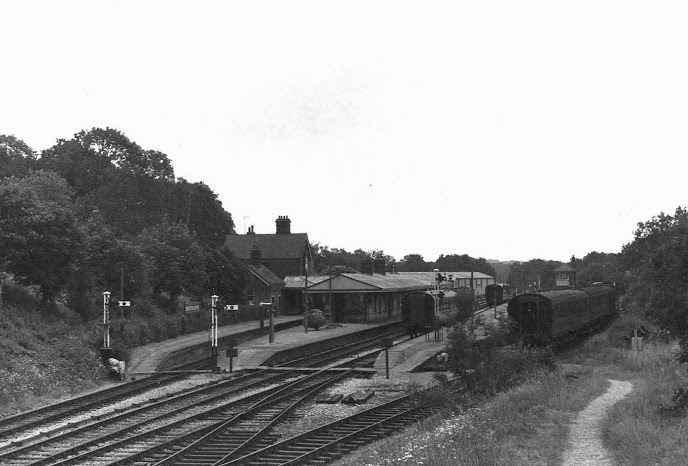
I became interested in disused lines long before I got involved with the real thing, and as a teenager got to look at many lines, the Midhurst lines, the Selsey Tramway, Cuckoo line, Lynton and Barnstaple, Meon Valley, Gosport, Hayling Island etc, all visited via rail and then on foot. I loved the atmosphere. It's ironic that over the last 15 years I've been trying to encourage their reopening!

We won't see their likes again. With railways reopening everywhere all closed lines are under threat. make the most of them whilst they are still there ...


Fittleworth 15.5.1977


Beeding 20.11.1986


Baynards 20.5.1977


Selham 3.7.1977


Itchen Abbas 24.6.1976


Mold 2.4.1985

a glimpse into the future


(Copyright Tim Hall)


This is a lovely shot from the fantastic Perrygrove Railway in Gloucestershire. Whilst the less aware amongst us may think of this as an image from the past to me it's very firmly and uncompromisingly an image of the future. The Perrygrove line uses the principles of Sir Arthur Heywood, a man so far ahead of the curve that we still haven't caught up with him! He promoted the 15 inch gauge as the minimum for real railway work. The costs are far lower than for standard gauge or indeed two foot, yet using careful engineering principles trains can carry worthwhile loads.

Unfortunately the brief petroleum interlude stopped development in the bud, but it's clear that as we leave that age then we will simply take off from where we left it, and 15 inch gauge lines will fill a very useful transport need in many parts of the UK.

The beauty of steam power of course is that it can use WOOD as a fuel source. Wood is infinitely sustainable and packs in almost as much energy as the sort of coal that's left. Any half decently managed railway in the future will, with careful woodland management, be able to provide all its own raw materials for energy (and sleepers, building materials etc), making any such line resilient and very profitable.

This is the future. Heart warming isn't it?

Wednesday, 12 March 2014

Rebuilding Midford!

MIDFORD STATION REBUILDING


We’ve reached that special time in the history of the New S&D when we can begin to rebuild our first station! At the last AGM it was decided that the appeal to raise the money needed to rebuild the iconic station at Midford would be launched in March 2014.

We expect to need somewhere in the region of £40,000. Remember we already own the station so the funds are for the materials etc to rebuild the station buildings, put in services, signage, cosmetic signals etc. The completed station will then become an information point for the rebuilding of the line and will also become a visitor centre. Hopefully there will also be some office/storage space as well!

Donations of any size are welcomed. You can donate using Paypal (to SDRHTSales@aol.com) or by cheque (payable to ‘New Somerset and Dorset Railway’ sent to New S&D (Midford Appeal), 10 Bellamy Avenue, Hartcliffe, BRISTOL, BS13 0HW.

Remember volunteers are always welcome to help with the current clearing and maintenance of the site – for info please email leysiner@aol.com

This is a very exciting time to be involved with the restoration of this iconic station and line!
Please remember we can also take donations in the form of used stamps or coins (please see website http://www.somersetanddorsetrailway.co.uk/fundraising/ for more information).


EVERY PENNY HELPS!

Tuesday, 4 March 2014

chattenden and upnor


(Copyright Max Sinclair)


The Chattenden and Upnor Railway (later known as the Lodge Hill and Upnor Railway) was a narrow gauge railway serving the military barracks and depot at Upnor and associated munitions and training depots. It was built in 1873 as a 18 in (457 mm) gauge railway, converted to 2 ft 6 in (762 mm) narrow gauge around 1885, and continued in use until 1961.

The Chattenden and Upnor Railway was originally laid in 1873 to 18 in (457 mm) gauge, as a training exercise for the Royal School of Military Engineering which was then based at Chattenden. The line ran from Pontoon Hard by the River Medway and climbed steeply towards Chattenden. A spur lead from Church Crossing to the Upnor Depot of the Royal Engineers and until 1895 a branch ran from Chattenden to Hoo.

In 1885 the railway was relaid and converted to 2 ft 6 in (762 mm) gauge by the 8th. Railway Company of the Royal Engineers who managed the line. In 1891 the Admiralty took over Upnor Depot to use as a gun and ammunition store. Another armaments depot was constructed at Lodge Hill, north of Chattenden which was also served by the railway. In 1905 the entire Chattenden enclosure was taken over by the Navy, and in 1906 the railway was also taken over by the Navy and renamed the Lodge Hill and Upnor Railway. The Navy extended the line to connect with the 4 ft 8 1⁄2 in (1,435 mm) standard gauge branch from Sharnal Street on the South Eastern & Chatham Railway's Hundred of Hoo branch.

The railway saw intensive use during the Second World War, but use declined after the end of hostilities and the railway closed in 1961.

More pics here.

Saturday, 1 March 2014

intriguing


Pics via Google Images.


A few days ago a similar picture to the above was posted to Disused Railways and it brought an immediate response from many members! Everyone was fascinated by it. It appears to be a street running NG line in a British street. I'd certainly not seen anything like it (apart from some very short stretches of NG inset track in SW London back in the 80s that was part of a waterworks system) so I spent an hour or two doing some research.

It turns out that the line is in Shrewsbury, very close to the old Abbey station. The track is still in situ (probably not worth the bother of lifting it!) but the line is no longer used.

The track is 7 1/4" gauge and was used to move freight around the yard. Whilst it appears to be on a public road it probably isn't, it's more like a paved back alleyway. I haven't been able to find out when the line closed, but I would imagine 10-20 years ago. There were two locos used, a diesel outline and a steam loco - both were miniature versions of full size locos rather than Heywood style engines (which is a shame). It appears the chief product handled was sugar. The line went into one or two buildings. Length was in the region of 300-400 metres going by the map (below). It's likely that the track in the buildings has been lifted.

So if you get the chance take a look. As stated above it's near the old Abbey station, off Abbey Foregate. The arch in the distance is next to Home Bargains. 

So the line had several unusual if not unique features. It seems to have been used for freight only, it ran mainly on-street and is still there! More info always welcomed of course - please email to leysiner@aol.com.


'Main' line on right with siding to building on left.

Map of line, red is in situ, blue is lifted.

We always love to hear about unusual bits of line, open or closed. If you know of anything like this please email leysiner@aol.com or post to one of the Facebook groups!

Sunday, 16 February 2014

bluebell branches out


(Photos copyright Steve Sainsbury/Rail Thing) 


I grew up in Sussex and the Bluebell was a constant presence to me. Loads of people talked about it, everyone I knew visited it and I got to go every year or so. I even joined and volunteered and spent one frosty day working on the track, but back then my only way of getting there was to go to Haywards Heath and walk or go by motorbike.

Back then of course it was a lovely, rural four mile long classic branch line, but things have changed a lot since then! I have done the extension to Kingscote but yet to do the East Grinstead stretch, but I have my eyes on a Steam Tours trip from Alresford to Sheffield Park in October!

The Bluebell has always been rather ahead of the game and have cleverly built their Network connection before oil supplies get tight, which will allow them to continue to bring in visitors and volunteers long after cars are just a fading memory.

And less than a year after making that Network link they are talking about their second! They have owned much of the Ardingly branch for years. Now with East Grinstead reached they can start to redirect their energies towards Haywards Heath.

The Haywards Heath-Ardingly-Horsted Keynes route was always an odd one. It was electrified for a start! It also had a very odd destination - the huge former junction station of Horsted Keynes stuck in the middle of nowhere. No doubt it survived the closure of the main line from Lewes to East Grinstead because it was electrified, but it did eventually close in 1963, leaving the Bluebell isolated from the Network. Most of the line remained open for freight, and is still used by one stone train a day.

Bluebell's plans are to extend to Ardingly first, and then enter into a running rights agreement with the Network to allow them to reach the main line at Haywards Heath. Fortunately the Ardingly route has a separate line into Haywards Heath and there is room for a separate Bluebell station alongside the Network station. Land for this is already being looked at.

The Bluebell is estimating ten years (ie 2024) for this to be completed. When rebuilt this route will give an emergency Brighton-London route, and will also tap dkirectly into the south coast's large population of residents and holidaymakers.

There have been calls to make this route third rail electric, which would be fantastic, but there are health and safety issues, apparently. (Though surely this would apply to the whole Network??) I would love to see the units I grew up with on the south coast running in preservation. We shall see.

And after Haywards Heath is reached? I suspect that the Bluebell will at last start to look south of Sheffield Park, and rebuild that little lost stretch to Lewes. This will increase the flexibility and resilience of their network and will tap directly into traffic from Lewes, Eastbourne and that whole area of East Sussex. It will also create yet another possible diversionary route for the BML.

From a schoolboy's crazy dream in the 1950s to an embryonic network covering a big slice of rural East Sussex, the Bluebell is a magnificent example of the possible and should inspire all of us!


Barcombe 4.7.1977 (copyright Steve Sainsbury/Rail Thing) - the final piece of the jigsaw!

Tuesday, 4 February 2014

an unusual closed railway ... or tramway?


All taken 16.4.1986 copyright Steve Sainsbury

The Weymouth Tramway was a fascinating line that ran through the streets of Weymouth to the Channel Islands ferry station at Weymouth Quay. The line lost its freight services in the late 1960s but passenger trains continued for about another 15 years, which gave people the chance to see the incongrous sight of long trains running tramway style through Weymouth streets.

The line did close when the ferry service began to run down, but in 2014 the tracks are still in place throughout, and calls for the line to reopen as a tourist attraction are inevitably made. There must be a reason why the line has remained in place - perhaps by lifting the line Weymouth would be admitting to the world that it was just another seaside town with no unique features? A reopened tramway would of course bring in hordes of new visitors to the town and it does seem off that even today we are STILL waiting for this obvious tourist honeytrap to open!

It's not just the street running that is fascinating but also the riverside run, where trains used to brush past boats. It will become possibly the biggest tourist attraction along the south coast when the locals and businesspeople finally twig what a unique asset they have, sitting there just waiting to be used!


(Copyright Steve Sainsbury)

In happier times class 33 6533 heads a Waterloo train past the Esso garage on 7 August 1973. Whilst this scene may not be recreated, perhaps in 2020 a modern tram would be taking the same route?