Showing posts with label Cuckoo line. Show all posts

Friday, 22 July 2016

Tunbridge Wells Ghost

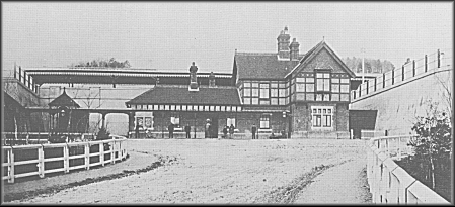
TUNBRIDGE WELLS WEST


(All 31.8.1988 Copyright Steve Sainsbury/The Rail Thing)


For a station and line that closed in 6 July 1985 it was something of a surprise to find that, just over three years later, the tracks were still down and the station and other buildings still standing. I suspect that this will be my last ever brush with the gothic glory of a large railway station entering decay, because they just don't close railways any more!

This was just about the last real railway closure in the UK. A few other short stretches of lines have closed since, but they have all found a new rail use, usually as a tramway. Indeed this line also has as well, but as a heritage line linking a new station at Tunbridge Wells with the Network station at Eridge. But back in 1988 this was all in the future, and the line had fallen into total disuse.

Amazingly the line closed for the sake of £175,000(!!!), the quoted cost of incorporating Grove Junction into the newly electrified Tonbridge to Hastings line. This short section through a tunnel just to the east of the West station remains disused, but is protected for future rail use.

The line saw diesel units for a while after closure, these were stabled at the depot there until new arrangements could be made. This meant the infrastructure stayed in place a little longer.

The Spa Valley Railway has gradually reopened the stretch back to Eridge where cross platform interchange is made with Network trains running up from Uckfield and down from Oxted and beyond. This gives the heritage line useful resilience and also the potential for future community traffic.

Looking further ahead it's likely that many other lines long disused in this area will reopen as the oil runs out and more and more traffic goes to the railways. This includes the iconic Cuckoo line which runs south from Eridge to Polegate near Eastbourne, the useful route from Eridge via East Grinstead to Three Bridges and, of course, the soon to be reopened Lewes-Uckfield line. Bearing all this in mind, plus the progress already made at the Spa Valley, these pics really do show the low point of Tunbridge Wells West's fortunes. I have mixed feelings - gratitude that I got to see this but perhaps regret that I didn't see it in its glory days - and will probably miss seeing the whole network reopen.

Tuesday, 14 October 2014

singleton


Before opening.


The subway in 2002.

(Copyright Chris Bedford Dumpman Films)


How it is now.


Nestling in a gap in the South Downs a few miles north of Chichester is one of the most fascinating closed stations of all.

Singleton's a small, fairly quiet village, but it holds a secret! A big closed station, now masquerading as a vineyard. 

If you're driving up from Chichester there's a clue as to why Singelton had such a big station Goodwood Race Course, which sits high on the Downs to the east of the village.

Singleton was on the Chichester to Midhurst line, opened in 1881. Traffic was always fairly sparse, but Singleton was different. It was designed as the station for Goodwood. It had four platforms connected by a subway, buffets, holding sidings for trains, a large goods shed and TWO signalboxes!  Whilst popular with King Edward VII the hoi polloi preferred Chichester station as the walk to Goodwood was easier!

Other stations on the line were far more basic with single platforms, but all sported elegant tile hung buildings in a similar style to those on the Bluebell and Cuckoo lines. Passenger trains finished in 1935, freight on this section continued to 1953 and the final section (south of Lavant) lost its trains in the late 1980s.

But the stations are still there (apart from Midhurst) although serving very different purposes these days. I never had the guts to sneak into Singleton and take pictures unfortunately, but Lavant was a regular haunt for me in the early 1970s. This was a fantastic line cutting as it did through the Downs. Hopefully it will return in the future.

Film of the route (plus loads of other great Sussex stuff!!)

More info (via Wikipedia) 

Singleton railway station served the village of Singleton in the county of West Sussex in England. The station was on the former line between Chichester and Midhurst. It was opened on 11 July 1881.
The station, designed by T. H. Myres, was built in a grand way by its owners the London Brighton and South Coast Railway, which included four platforms, with a subway linking them and the 'Country House' style station building, buffets, long sidings for awaiting trains, a large goods shed for dealing with freight, and two signal boxes to control the station. The main reason for this large building was to deal with visitors to the Goodwood Racecourse, but passengers preferred to use Chichester Station mostly due to the walk uphill to the course from Singleton. It was one of the most visited stations by the LBSCR Royal train as the prince of Wales (later Edward VII) used to 'weekend' with the James family at West Dean House. Little other traffic was ever found, and despite all of the grand hopes, passenger services were withdrawn on 6 July 1935. Freight services remained until these were withdrawn on 28 August 1953 by British Railways. The station is now in use by a vineyard owner.

Sunday, 16 March 2014

The other Kent and East Sussex


Eridge 2.1.1973


1317 at Groombridge 4.7.1977


Tunbridge Wells West 31.8.1988 

(All pics copyright Steve Sainsbury/The Rail Thing)


By the mid 1980s railway closures were a fading memory, but in a last burst of misplaced nostalgia there was one final closure down south, when the useful (but not as useful as it will be!) route from Tunbridge Wells to Eridge was closed. The excuse was the expense of remodelling the junction at Tunbridge Wells when the main Hastings line was electrified ... and so another part of the network of lines in this area had to close.

The line was quickly resurrected as the Spa Valley Railway, but a few tourist trains hardly compensates for the loss of a seven day a week service. And that important link at Tunbridge Wells is STILL devoid of track.

I got to travel on this line a few times and it was a nice rural route. I must admit that by the 70s a lot of the line's purpose had gone. Once it had provided a gateway to lines to Brighton, Lewes, Eastbourne, East Grinstead and Three Bridges, offering a huge range of trips and keeping a good bit of traffic off the roads. It also made commuting an easy proposition in a whole swathe of this region. By 1985 it really just provided a link between Tunbridge Wells and Uckfield (Lewes no longer being an option) and also allowed people in the West of Tunbridge Wells to access the Network (and London) via the large and gothic station at Tunbridge Wells West.

So the line was closed, the last real closure of any substance in southern England and possibly the whole country. A final fling for Beeching and his empty headed accountant hordes.

But things are stirring. As mentioned above a good stretch of the line is now a tourist railway, but the Lewes-Uckfield line is on the cusp of reopening, there are murmurs about the useful 'Cuckoo' line to Eastbourne and the East Grinstead line now has a group working with banks and others in the area to reopen this useful link (at least for a few more decades) to Gatwick Airport and, more importantly, the Brighton main line. East Grinstead of course has had it's other line (to Sheffield Park) reopened last year, and the Bluebell have a 25 year and beyond plan that mentions a possible return to Lewes. The whole area will be transformed for rail.


Withyham 4.7.1977

Still in deep sleep the useful route from Eridge via East Grinstead to Three Bridges is beginning to stir again.

Saturday, 27 August 2011

will the cuckoo make a comeback?


(Horam, 1960s copyright Rail Thing)


This is Horam station on the famous Cuckoo line, which ran from Polegate to Eridge and was closed in 1965, apart from the section from Polegate to the large town of Hailsham which survived until 1968.

In retrospect this was a particularly stupid closure. Hailsham is far too large to not have a railway service and is certainly paying for it now! But the line also provided an excellent alternative route from Eastbourne to London, and also served several other small towns en route. It may well be sooner rather than later that reopening of this route takes place, for the reasons listed abiove, and also because of the coming revival of British seaside resorts as more and more people choose to holiday at home rather than bear the strain (and soon prohibitive cost!) of flying to more exotic destinations. One of the big advantages of this route is that it will take some of the pressure off the current sole connection between Eastbourne and London (via Lewes and Haywards Heath) which becomes particularly congested where it joins the Brighton to London line.

Generally the closure of rail routes to British seaside resorts in the 1960s was clearly a huge mistake. It is barely believable that important seaside towns such as Ilfracombe, Bude, Padstow, Lyme Regis and a host of others are currently struggling with roads (LOL!) instead of having modern transport drop thousands of visitors on their doorsteps. This will have to change, and fast!

More info on Horam station (from Wikipedia)

Horam railway station was on the Cuckoo Line between Hellingly and Heathfield, serving the village of Horam.

History

The station was opened by the London, Brighton and South Coast Railway on 5 April 1880 and was originally named Horeham Road for Waldron. It was on the line extension from Hailsham to Eridge. It was renamed several times: on 1 June 1890 it became Horeham Road and Waldron; on 1 April 1900Waldron and Horeham Road; on 1 January 1935 Waldron and Horam; and it finally became Horam on 21 September 1953.
The station closed to passenger traffic on 14 June 1965 but freight trains continued to pass through until 1968 when the line was closed completely.
Preceding stationDisused railwaysFollowing station
Heathfield
Line and station closed
 British Rail
Southern Region

Cuckoo Line
 Hellingly
Line and station closed

Present day

The Cuckoo Trail foot and cycle path runs over one of the platforms. Sections of the two platforms including a concrete nameboard,some lamp posts and seats are preserved. The rest of the station site is now a housing estate and a car park.

More info on the Cuckoo Line (from Wikipedia)

The Cuckoo Line is an informal name for the now defunct railway service which linked Polegate and Eridge in East SussexEngland, from 1880 to 1968. It was nicknamed the Cuckoo Line by drivers, from a tradition observed at the annual fair at Heathfield, a station on the route. At the fair, which was held each April, a lady would release a cuckoo from a basket, it being supposedly the 'first cuckoo of spring'. The railway line served the following Sussex communities: PolegateHailshamHellinglyHoram for WaldronHeathfieldMayfieldRotherfield and Eridge. Services continued through Eridge and onward via Groombridge to Tunbridge Wells.
The Hailsham-Eridge section closed in 1965, the Polegate-Hailsham branch surviving until 1968. Eridge-Tunbridge Wells closed in 1985, and this line has been resurrected as the Spa Valley Railway.

History[edit]

The Cuckoo Line was built by the London Brighton and South Coast Railway (LB&SCR) in two sections, starting with the branch from Polegate to Hailsham which opened to traffic on 14 May 1849. The remainder of the line to Eridge was engineered by Frederick Banister, and opened to traffic in September 1880.[5] The station buildings were designed by Banister's son-in-law, Thomas Myres.
The line from Three Bridges to Tunbridge Wells (via East Grinstead High Level and Groombridge) opened on 1 October 1866, with the connecting line from Uckfield via Eridge opening on 3 August 1868. The final part of the route opened on 1 February 1876: a connection between the LBSCR station at Tunbridge Wells West and Tunbridge Wells Central, the station operated by the South Eastern Railway (SER). This single-line section passed through the short Grove Tunnel to Grove Junction, sited a little south of the SER station on its Hastings Line. In 1881 a new track alignment was built between Polegate and Hailsham allowing trains to run into Polegate at the west end of the station and direct to Eastbourne.
At the 'Grouping' in 1923, the railway passed into the control of the Southern Railway. When the Southern Railway was nationalised in 1948, the line became part of the Southern Region of British Railways.
Following the Beeching Report in 1963, the line was recommended for closure. The section from Eridge to Hailsham was closed to passenger traffic in 1965 (the section between Heathfield and Hailsham remaining open for freight until 1968), whilst the short branch from Polegate to Hailsham remained open until 8 September 1968. The closure of this section was hotly disputed – even British Railways itself agreeing that Hailsham was a growing town and that buses would be unable to cope with the demands of the increasing population.
The line between Eridge and Tunbridge Wells West remained open until 1985. Despite having survived 'Beeching', no money was spent on the line and British Rail regarded a track and signalling upgrade to be unviable. Closure was announced in February 1985, and the last passenger trains ran on 6 July 1985. Grove Junction was removed the day after closure, but the depot at Tunbridge Wells West remained in use for another month.

The Cuckoo Line today

See also: Spa Valley Railway
Today, the Cuckoo Line remains a closed railway – a footpath and cycleway known as The Cuckoo Trail runs along much of the route from Polegate to Heathfield. Polegate retains a railway station, albeit on a different site to that formerly used by Cuckoo Line trains, whilst the site of the station in Hailsham is now occupied by a housing estate and a public car park. Hellingly station survives as a private residence. At Horam the platforms are preserved including a nameboard. Heathfield station building is now a shop selling kitchen utensils but the site of the platforms is now occupied by industrial units. At Mayfield the station building survives as a private residence but the trackbed has now been removed and replaced by the A267 Mayfield bypass. Rotherfield and Mark Cross station is a private residence. Soon after closure of the Eridge to Tunbridge Wells West section, a preservation society was formed with the intention of reinstating the passenger service on the line. The Tunbridge Wells and Eridge Railway Preservation Society (TWERPS) acquired the line in March 1996 and by December 1996 had started to run a steam-hauled passenger service along part of the route. The line has been marketed as the Spa Valley Railway and it has gradually extended services with the final section to Eridge opening on the 25th of March 2011.
Shawpits Bridge, near Hellingly
Cuckoo Trail between Polegate and Hailsham

Accidents[edit]

D1 Class No. 297 Bonchurchand train, derailed at Tooth's Bank, North of Heathfield, September 1897.
The line had a good safety record: there was only one reported accident on the line. On 1 September 1897 at Tooth's Bank, 2 miles north of Heathfield, the 08:18am service from Eastbourne was running around 4 minutes late and was trying to pick up time in order to meet a connecting train at Groombridge. As the train entered the curve at around 40 mph it left the tracks. Driver James McKinlay was killed and Fireman Lewis Minns seriously injured, whilst 30 passengers suffered minor injuries. At the subsequent inquiry, Lt. Col. G. W. Addison reported that the main cause of the accident was excessive speed as the driver was attempting to make up lost time in order to make a connection at Groombridge. The track itself was in poor shape with many rotten sleepers and "curves having irregular elevation" which contributed to the accident. Following the inquiry, much of the track was relaid and the train scheduling was altered.
In April 1968 a lorry collided with a low road bridge under the line at Horsebridge north of Hailsham damaging the bridge causing immediate closure of the line. As the freight train service between Hailsham and Heathfield was due to be withdrawn the following month it was not considered worthwhile repairing the bridge so the line was prematurely abandoned forthwith. Some wagons isolated at Heathfield goods yard were cut up on site.

Route description

The Cuckoo Line diverged from the main Eastbourne to London line at Polegate, and ran northwards on a single track to the market town of Hailsham, which was the terminus for 31 years until the line through to Eridge had been completed. The line then passed through the villages of Hellingly (where a link to the Hellingly Hospital Railway joined the route, worked by overhead electric traction), HoramHeathfieldMayfieldRotherfield & Mark Cross, then via Redgate Mill Junction to join theOxted Line for Eridge. The route continued north-eastwards, leaving the Oxted Line at Birchden Junction heading for Groombridge, High Rocks Halt and eventually Tunbridge Wells West. Through trains could continue on the single-track connection through Grove Tunnel to join the Hastings Line (heading towards Tunbridge Wells Central) at Grove Junction.

Name changes

Horam station was originally built as Horeham Road. In 1900 it was renamed Waldron & Horeham Road. Over the years, Horeham changed to Horam as the hamlet grew around the station, prompted by growth including an Express Dairies depot, and the name changed again in 1935, before becoming simply Horam in September 1953.