


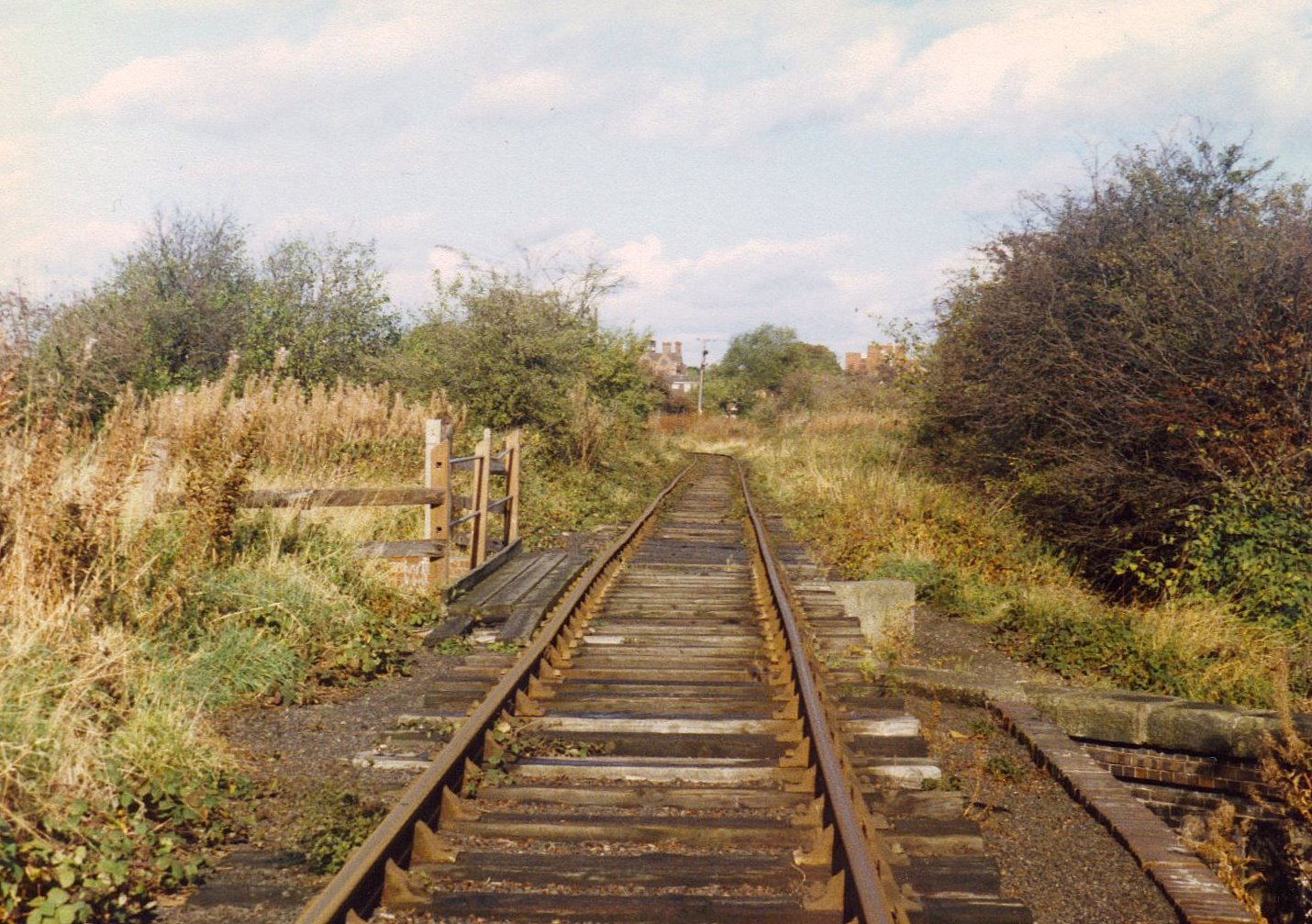


(All copyright Steve Sainsbury/Rail Thing 22.10.1986)
25 years ago there was still a short section of the erstwhile Shropshire and Montgomeryshire Railway that had track and occasional freight workings. This was a mile or so in Shrewsbury and ran to the site of the Shrewsbury Abbey station. This was an interesting line with a chequered history but it survived intact until the early 1960s being operated by the MOD and serving ammunition dumps in the area. It had been closed a couple of times in the past before complete closure.
I don't imagine that this short stretch survives now though I stand to be corrected!

Maesbrook 1962 - back when more of the line still existed! Photo copyright Rail Thing.
The Shropshire & Montgomeryshire Light Railway was a railway running from Shrewsbury, England to Llanymynech, Wales, with a branch to Criggion. The line was taken over by the War Department in 1941, and extensively reconstructed to serve Central Ammunition Depot Nesscliffe. It was finally closed in 1960.
History
It opened in 1911, running the reconstructed Potteries, Shrewsbury and North Wales Railway which continunued to be owned by the Shropshire Railways Company, and was one of the Colonel Stephens Railways. It lost its passenger services in 1933, although some limited bank holiday services for tourists continued until 1937.
Operations
The terminus of the line was at Shrewsbury Abbey station not at Shrewsbury railway station. This was because the joint operators, Great Western Railway (GWR) and the London and North Western Railway (LNWR).[1] refused to let the smaller company have access to mainline services. After the main railway closed Shrewsbury Abbey was retained as an oil depot siding connected to a stub of the Severn Valley branch. The site finally closed in 1988. A new road in the area has been named "Old Potts Way" as a reminder of what was known as the Potts Railway.
A number of the stations shown in the diagram were added after the closure of the original Potteries, Shrewsbury & North Wales Railway.
CAD Nesscliffe
Main article: Nesscliffe
Central Ammunition Depot Nesscliffe was developed by the War Office/Ministry of Defence during World War II as an ammunition dump. To service the extensive property, the MoD took over the virtually defunct S&MR from 1941, and built extensive additional service tracks along the 8.75 miles (14.08 km) of railway line from Maesbrook to the former Ford and Crossgate railway station, south of the River Severn.
Like a typical ammunition depot, the site was laid out over an extensive area to avoid total destruction should an accidental explosion occur, or the site be attacked by enemy. The site was made up of four sub-sites: Kinnerley; Pentre; Ford; and Argoed. The four sites were capable of storing around 50,000 tonnes (55,000 tons) of shells.
There was also a sub-site at Loton Park, under the Alberbury medieval deer park, used for storage of both incendiary ammunition andchemical weapons shells from 1943. This was one of two CW depots operated in co-operation with and guarded by the United States Army Air Forces, the second being in Shepton Mallet, Somerset.
Locomotives and train drivers were provided by the Royal Engineers, who also maintained the extensive network. Their main servicing depot for rolling stock was on the stub-junction of the former branchline to Criggion.
Closure
Ammunition storage officially stopped in 1959 on site, and the ammunition depot closed in 1961, when the railway tracks were removed. Operational locomotives were moved to the Longmoor Military Railway, while non-operational were sold-off commercially.
Since this time, the 1,717 acres (695 ha) of flat pastureland have formed the British Army's Nesscliffe training area, capable of accommodation up to 530 personnel.
Locomotives
1907–1941

- 1 Gazelle 0-4-2WT Dodman, King's Lynn (preserved at the Colonel Stephens Railway Museum, Tenterden, Kent)
- 2 Hecate (1st) 0-4-2ST renamed Severn in 1916
- 3 Hesperus 0-6-0 ex-LSWR 282 Class "Ilfracombe Goods"
- 4 Morous 0-6-0ST Manning Wardle
- Walton Park 0-6-0ST Hudswell Clarke
- 5 Pyramus (1st) 0-6-2T new from Hawthorn Leslie in 1911
- 6 Thisbe (1st) 0-6-2T new from Hawthorn Leslie in 1911
- 5 Pyramus (2nd) 0-6-0 ex-LSWR 282 Class "Ilfracombe Goods"
- 6 Thisbe (2nd) 0-6-0 ex-LSWR 282 Class "Ilfracombe Goods"
- 7 Hecate (2nd) 0-6-0T ex-LB&SCR A1 Class Number 681 Beulah. Bought from the Government in 1921 after war service, scrapped 1930.[7]
- 8 Dido 0-6-0T ex-LB&SCR A1 Class Number 638 Millwall. Bought from the Government in 1923 after war service for £470 in November 1921. Scrapped 1931.
- 9 Daphne 0-6-0T ex-LB&SCR A1 Class Number 683 Earlswood. Bought from the Government in 1923 after war service .Withdrawn 1932. Sold to Southern Railway, January 1939, Scrapped atEastleigh, April 1949.
- Unnamed 0-6-0 ex-LNWR 17in Coal Engine
- Unnamed 0-6-0 ex-LNWR 17in Coal Engine
- Unnamed 0-6-0 ex-LNWR 17in Coal Engine
The Hawthorn Leslie locomotives were new in 1911 but all the others were second-hand. Both the Hawthorn Leslies left between 1914 and 1916. Thisbe and Pyramus were sold to the government in 1916 and seem initially to have gone to the Cannock Chase Military Railway. Thisbe went to the Woolmer Instructional Military Railway where she lasted until 1931 whilst Pryamus was sold for industrial use in 1921. They were replaced by two "Ilfracombe Goods" locomotives which took the same names.
1941–1960
Locomotive stock in 1941 consisted of: Gazelle, Hesperus and the three LNWR 0-6-0s. These were supplemented by various War Department locomotives, including ex-GWR 2301 Class 'Dean goods' 0-6-0s and Hunslet Austerity 0-6-0STs. From 1945, the Criggion branch was operated by a Sentinel steam locomotive (works no. 7026) owned by the British Quarrying Company.


